What can be seen in the picture
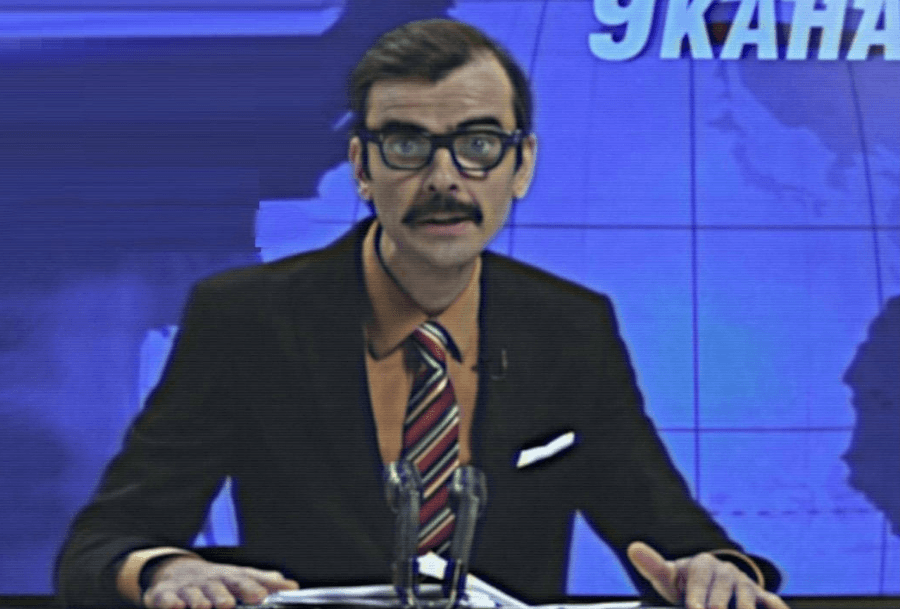
The frame shows a man with neatly combed dark hair, a thick moustache and square glasses with black frames. He wears a dark jacket, an orange shirt and a striped tie, with a white handkerchief in his breast pocket. In front of him on the table are microphones, and in the background is a blue backdrop with a world map and a fragment of a large inscription. The image is grainy, with color interference, like an old video recording. All of this imitates a news broadcast from late-Soviet or early post-Soviet television.
The facial expression is concentrated and slightly anxious: the presenter looks into the camera as if he is about to announce something very important.
What “Inside Lapenko” is
“Inside Lapenko” is a Russian comedy project by actor Anton Lapenko. It began with short sketches on social networks and later moved to YouTube as a mini-series. Reportedly, the first episodes appeared on that platform in December 2019, while earlier, in spring 2019, the project gained popularity thanks to clips on Instagram. Different sources give different exact dates.
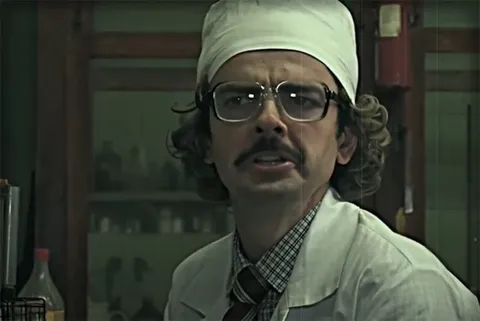
The main feature of the series is that Lapenko plays all the roles himself: among its characters there are an engineer, a TV presenter and members of fictional music groups. The stylisation after 1980s–1990s videos and many references to Russian films of that time made the project recognisable. The frame with the presenter in glasses belongs to this television line.
Why the frame became a reaction
The news presenter embodies a seriousness that does not match the occasion. Old film, a persimmon-coloured shirt, a moustache and resounding officialdom create a funny contrast with any everyday event. If you attach news about a missing sock to such a frame, the joke works immediately.
The second mechanism is nostalgia. For people who remember the real broadcasts of those years, the image is recognisable and evokes a warm smile, while a young audience perceives it as a funny “retro filter.”
A presenter in this guise is also convenient because any news can be inserted, from household to purely personal. Since the frame looks like a piece of archive programming, the viewer instantly reads the intonation and fills in the rest on their own. That is why captions are better written like headlines: short, with deliberately official words such as “it is reported” and “the situation remains tense.”
Examples for your own caption
“Urgent: the office kitchen has run out of tea, the situation is under control” — a classic piece of news about a trifle in a solemn tone.
“On air, the segment ‘What I meant to do at the weekend’: results — nothing done” — a report on one's own laziness as a news summary.
“Mum called and asked whether I had eaten. Details in the next episode” — a domestic remark as a news story.
The joke works because the format of a strict broadcast emphasises the insignificance of the subject.
How to use the template
The frame suits short “breaking news,” reports of minor troubles and parody of official statements. The text is best placed at the bottom or over the blue background on the left, so as not to cover the face.
If you mention the series, remember that this is the actor's role: the frame cannot be used to judge the character of the man himself.
A good device is to add a second line, like a scrolling ticker at the bottom of the screen. The contrast between the serious presenter and a petty incident is intensified if the message describes something utterly trivial in detail, for example a dispute over whose turn it is to take out the rubbish.