Laughing against a dark red curtain
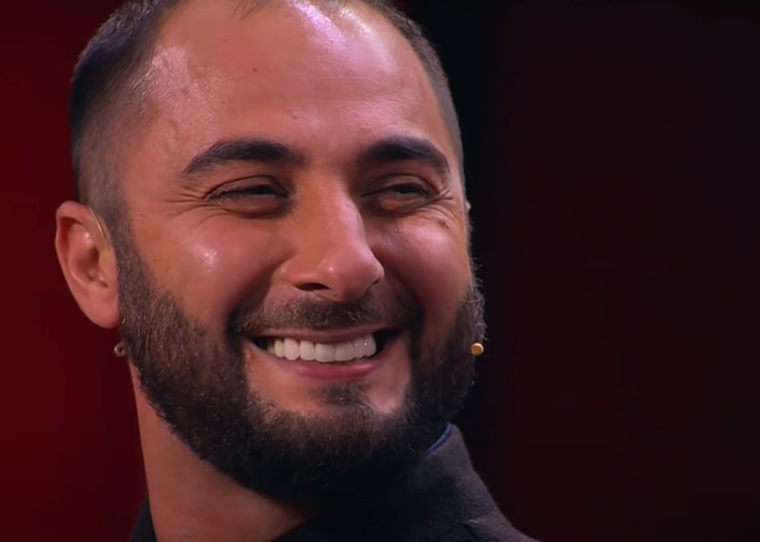
The close-up frame shows a man with short-cropped hair and a neat beard. He's smiling broadly, his eyes almost shut with laughter. The background is dark red, resembling a curtain or studio wall, with small light-colored details visible in his ears. There's no caption on the image — it's a plain frame.
It's precisely the facial expression that makes the template so useful: the man isn't angry, he's genuinely, almost warmly, amused. That cheerfulness creates the main contrast with the accusation being voiced.
Where the phrase came from
The expression is linked to the comedy show "Comedy Club" and comedian Demis Karibidis. Reportedly the phrase was said in a sketch involving another cast member of the show; the exact episode, the scene partner, and the air date remain unconfirmed, and the precise date is unknown.
The phrase's mass spread on social media is dated to 2020 — though this is more likely the time the meme became popular than the date of the performance itself.
How the accusation reads
"Lya" here functions as a short exclamation, as if the speaker is catching the other person red-handed. The word "krysa" ("rat") colloquially means someone who schemes, hoards what's theirs, breaks an agreement, or takes advantage of others' trust. The overall tone isn't angry but theatrically outraged, so the phrase sounds like a playful "gotcha" rather than a real quarrel.
The meme is applied to minor everyday situations: someone ate the last cookie, didn't pay back a hundred rubles, pretended not to see a message, or secretly watched an episode without their friends. The smaller the offense, the funnier the loud accusation.
Example captions
"When a friend promised not to watch the finale without me, and is already texting spoilers in the chat." Here the violation is tiny and the reaction is huge, and that mismatch is exactly what's funny.
"A coworker who said they'd just step out for five minutes, and came back with coffee only for themselves." The caption shows the kind of petty behavior any viewer instantly recognizes from their own experience.
"Me, discovering that the only candies left in the shared box are the ones nobody likes." The accusation targets an invisible culprit, and the viewer fills in the scene themselves.
"The cat, who pretended it wasn't him who knocked over the mug." We call out someone who can't talk back, which only underscores how comical the situation is.
How best to use the template
The image works best in a "situation plus accusation" format: a short description of the offense on top and the phrase below — or no phrase at all when it's already obvious. The laughing face conveys well that the speaker himself isn't really that upset.
The phrase fits among friends and in everyday jokes. If used seriously against a real person in an argument, the joke's point disappears and only the reproach remains. The meme runs on playfulness, so the offense needs to be small and recognizable.
An inverted version also works well: a person admits their own petty "rat-like" behavior themselves, for instance, hiding the best piece of cake for tomorrow. Self-deprecation defuses any edge and makes the joke warm.