Cubes as movable letters
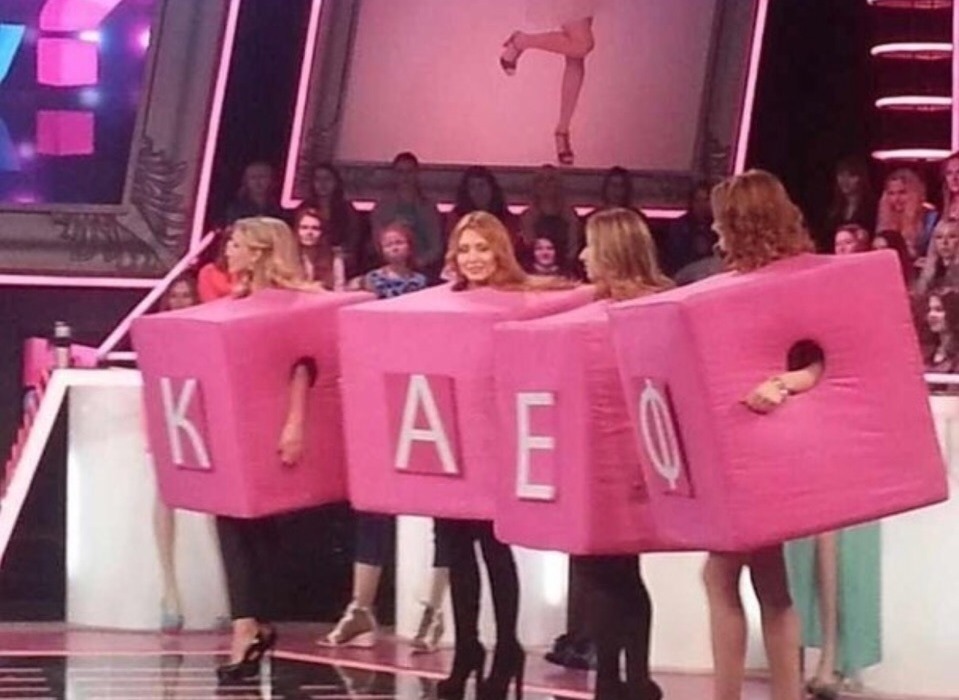
The photo shows four women standing side by side in large pink boxes. On the front faces, big white letters form “KAEF”; their faces show above the top edges, and arms and legs poke out through slits. In the background are spectators, stage lighting and a large screen. The costumes and placement of the letters show the contest's task: the team has to build a readable word out of scattered letters.
The frame was shot during the game show “Who's on Top?” (Kto sverkhu?), in which men's and women's teams competed in game tasks. One round required putting on cube costumes with letters and arranging themselves in the correct order. The scene captures exactly that task: the word appears not on a poster but on the participants, who must be letters and part of the line at once.
Why it was read as “kaef”
The ordinary Russian word is “kayf,” and “kaef” looks like a colloquial, deliberately odd spelling of it. Two things matter in the photo at once: the word reads like a ready-made comment on what is happening, and yet it is assembled from separate letters on the costumes. Each participant wears only part of the inscription, and the meaning emerges only from the whole chain. The twist is not that they say anything: it is the visual accident of the order in which the cubes happened to stand next to each other.
The word does not explain why the participants are supposedly happy, and it is not the name of the contest. It works as a ready-made short reaction that the viewer adds to the scene after it appears. This is the transformation: a game task about assembling letters becomes a collective exclamation, as if the whole row of costumes were voicing approval of a successful moment with one voice.
From game show to caption for joy
The meme reading has two sources of comedy. The first is a random phrase on the costumes that seems to fit almost any moment of happiness; the second is the mismatch between the serious focus of a game round and the enthusiastic meaning of the word. So one frame can illustrate both a small pleasure and a big team victory: the four participants already stand as a single inscription, although on the show each of them was responsible for only one letter.
The TV contest came several years before the meme caption: the frame first existed as a game moment, and only in July 2018 did people start applying it to pleasures and lucky coincidences. From then on the participants were no longer simply a team assembling a word for speed; in the new reading they seem to say the approving “kaef” themselves. The meaning thus moved from the rule of the game show to an emotional comment.
Invented occasions for “KAEF”
“Five minutes until the end of the workday, and no urgent emails left” — the imagined caption turns relief into an award ceremony. “Found a concert ticket in my jacket pocket for a show that hasn't happened yet” explains where the good mood came from. “There was exactly one slice of pie left in the kitchen, and nobody is arguing over who gets it” — an even smaller triumph also gets a full-screen caption. All three occasions are invented. They suit the image because the assembled word already sounds like a short approval, and the separate participants in heavy costumes turn a private feeling into a shared team victory.