What the picture shows
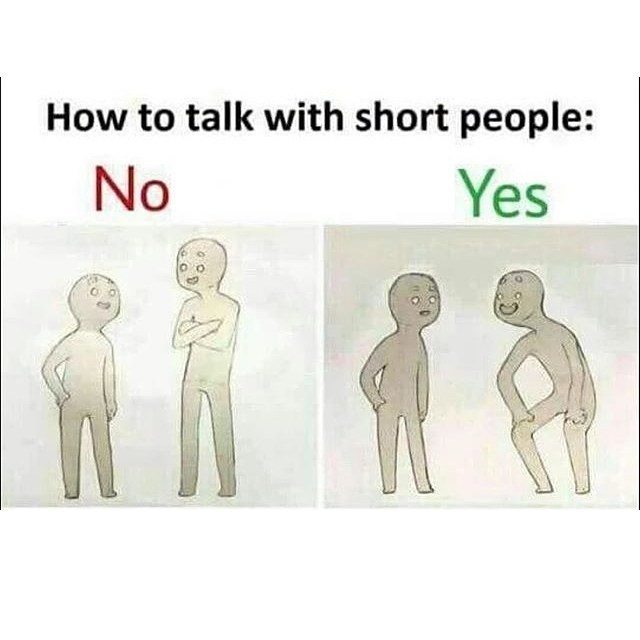
The image is split by a vertical line into two parts. Above them is the caption "How to talk with short people," and in Russian-language versions, "How to communicate with short people." Above the left half, written in red, is "No"; above the right half, in green, is "Yes." The figures are drawn in a simple pencil-sketch style: faceless gray little people with large round heads and dot eyes, so all the attention is focused on posture and proportions.
In the left panel stand two characters: a short one with hands on hips, and a tall one with arms crossed over the chest, looking down at the other person. This composition reads as a typical scene of condescending communication. In the right panel the short character stands in the same pose, while the tall one bends his knees and leans down, almost crouching, to get to the same level as the other person and look him straight in the face.
Origin and history
The exact author and date of the comic's first publication have not been established. The drawing belongs to the genre of simple two-panel "right / wrong" pictures that spread widely across social networks, forums, and themed communities in the early 2010s. The date 2014 given in the catalog reflects the time when the image became noticeable online, but its original source remains unknown.
The format of "how to properly talk to..." was not invented by this particular drawing. Pictures like this have long existed on the English-language internet: the authors take an everyday situation, show two variants of behavior, and contrast them with each other. The irony is that the "correct" variant looks like an awkward, cartoonish accommodation rather than a model of politeness.
How it's used and typical captions
The image's main feature is its versatility. The headline "How to talk to..." can easily be swapped out for any group of people or situation, turning the two options, "No" and "Yes," into a template for ironic advice. Most often users substitute in categories of people with whom communication often causes awkwardness: the very busy, the exhausted, those who showed up unannounced.
Typical captions preserve the structure of the original comic: one manner is described as ridiculously condescending, the other as pointedly caring and therefore funny. For example, "How to talk to your boss" or "How to communicate with your parents" are accompanied by the same drawing, and the meaning becomes clear without any extra text.
Why the joke works
The humor relies on a recognizable social observation. Short people often encounter a patronizing tone and the habit of other people looking down on them, both literally and figuratively. The comic exaggerates this situation: the tall character with crossed arms looking down from above comes across as unpleasant, while the one who lowers himself to the other person's level looks almost ridiculous. The joke mocks both extremes, which makes it hard to read as a direct taunt against any specific person.
A second layer of comedy comes from the absurdity. The posture of the "correct" interlocutor is unnatural: the figure bends as if trying to fit into someone else's frame of reference, and an attempt to show respect turns into self-parody. The simplicity of the drawing also helps the meme spread: the faceless figures are not tied to specific people, and the short two-part structure can be read in a second and easily transferred to any context.