What is drawn
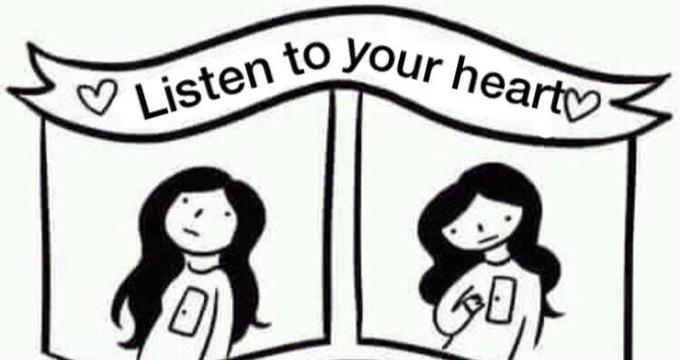
The picture is a black-and-white drawing: at the top is a banner with the words “Listen to your heart” and small hearts at its ends. Below it are two panels. In each, a girl with long dark hair and a loose sweater. On her chest is a small rectangular door with a round handle. In the left panel the girl stands still; in the right she raises her hand toward the door, as if about to open it.
It is noticeable that the frame is cropped at the bottom: it does not show what is behind the door. This is the core of the joke in the original comic.
Origin of the comic
Reportedly, the original was posted on Tumblr by a user named Spacepegasus on November 15, 2015. According to this version, behind the door is a heart that shouts “AAAAA.” For some time the post attracted almost no attention, but in early December 2015 it was posted on Reddit, and its popularity began to grow.
In 2018–2019 the comic was picked up as a template in which the heart’s line is changed. Precise details about the author and dates are based on discussions in English-language meme communities and are not considered fully confirmed.
Why the template works
The phrase “listen to your heart” is familiar to everyone as advice from motivational cards: trust your feelings, not calculation. The comic makes this advice literal: the heroine opens the door and listens to what her heart says. Instead of wise counsel, a scream, panic, or a pointless request comes out.
The contrast between the pretty presentation and what is inside creates the joke. The door emphasizes a sense of privacy: the “inner voice” is kept behind a lock, and in fact it turns out to be no better than any other noise.
Caption examples
“Heart: Eat this. Right now. It’s been in the fridge since yesterday.” The heart’s advice turns out to be an ordinary impulse.
“Heart: Text him. Brain: No. Heart: Text him.” The template becomes an argument inside the heroine.
“Heart: Buy one more cat.” The request sounds like a wise decision, but her budget is not happy about it.
“Heart: Sleep.” The shortest caption, and it works best because everyone believes it.
How to use the template
The caption is most conveniently written as a short line from the heart in the spirit of “Heart: …”. Requests tied to weaknesses work well: food, sleep, shopping, indecisive messages. The more mundane the desire, the stronger the contrast with the solemn banner.
Don’t explain the joke or add long commentary: the banner and one line are enough. If you need a second character, such as the mind, it is better to show it on a separate line so as not to break the template’s basic structure.
If one line from the heart seems too little, add exactly one clarification to it: what it wants exactly and why it is awkward to say it directly. Don’t overload the frame: in the original, the picture is built very simply, and all the joke’s force is concentrated in one line that sounds unexpectedly honest.
Another notable feature: the picture works without knowing the original. Even someone who has not seen the continuation understands that something is waiting behind the door and happily fills in their own.