What the image shows
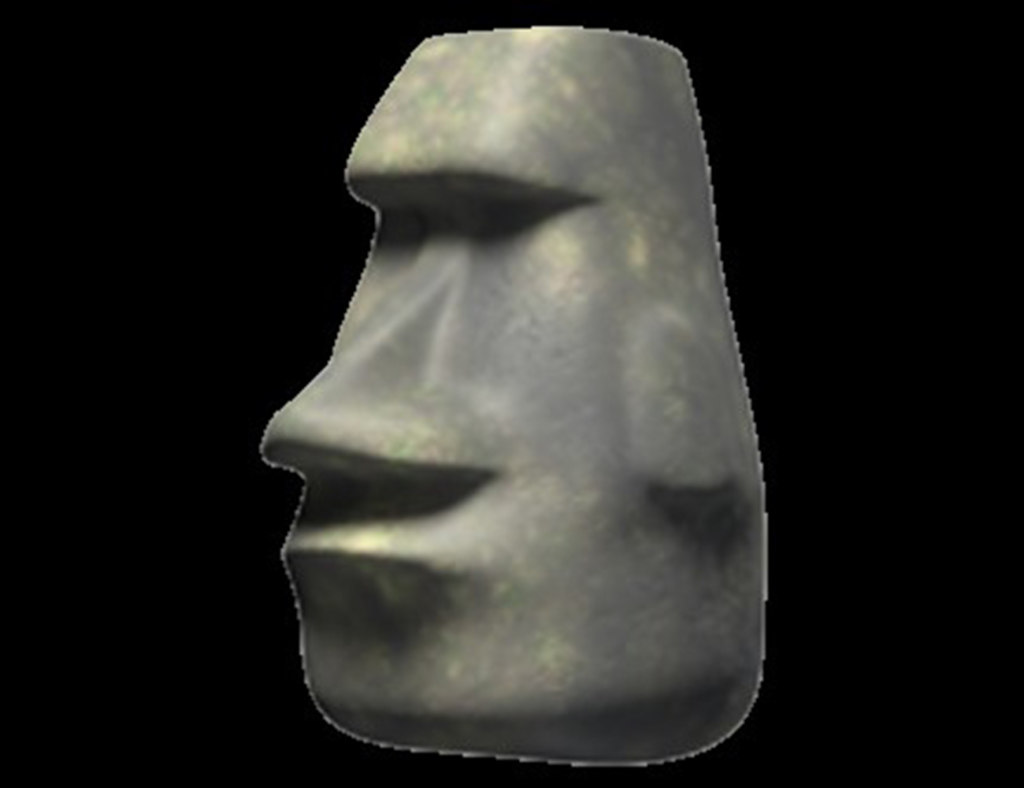
The image shows a three-dimensional stone head turned to the left. The background is solid black, the surface gray-green and mottled like old stone. The head has a rectangular forehead, a heavy shadow under the brow ridge, a long nose, tightly pressed lips and a massive chin. There are no eyes as such, only a deep shadow under the brow. This makes the face look both stern and empty.
This is not a photo of a statue but a drawn model from an emoji set. It has no caption or text of its own: all the meaning comes from the context of the message it is placed in.
Tokyo, Niijima and Easter Island
The emoji's prototype is not the statues of Easter Island themselves, but a moai sculpture near Shibuya Station in Tokyo. The idea was proposed in 1978 by Yuichi Daigo, a master craftsman from the island of Niijima, and the statue was unveiled on September 25, 1980: the island gifted it to the district for the centenary of Niijima's incorporation into Tokyo. The sculpture resembles the moai statues of Easter Island (Rapa Nui), but it was made on a Japanese island.
The character entered the Unicode standard in version 6.0 in 2010 under the name "moyai". So it began as just an icon taken from a Tokyo landmark, not as a meme.
How the stone sign became a reaction
How and when it caught attention on the Runet (the Russian-language internet) is not reliably known: there is no exact first post. But it is clear why it took hold. A face with no expression is perfect for when you want to say: "I get it, but I won't comment."
Later the symbol picked up shades of meaning: dry irony, feigned indifference, a "serious" tone set against an absurd claim, and deliberate toughness. Different groups read it differently, which is normal: an emoji mainly conveys tone, not fact.
Caption examples and why they work
"Colleague: this will take five minutes. Me: 🗿" The image stands in for a word you'd rather not say: the viewer supplies the skepticism, and the joke ends up shorter than any phrase.
"I was told tomorrow is a day off, and then they explained it was for a different department." Under such a caption the stone head expresses not anger but complete stillness after disappointment.
"Me when the cat watches me clear away its bowl." The contrast works: the image has no living gaze, but the caption gives it a judging look.
"My summer plan: 🗿" Here the image itself becomes the answer: standing there, doing nothing, and looking majestic while doing it.
How to use the image
The stone face works best as a reply rather than as the main joke: after a short line that contains a strange or overconfident claim. Don't add long text to it: the pause and brevity are the device.
The black background makes it easy to overlay text above or below, and the silhouette cuts out well if you want to place the head into someone else's photo. But keep its origin in mind: this is a symbol with real cultural roots, so in jokes it is better not to present it as a photo of a specific monument.