What is in the picture
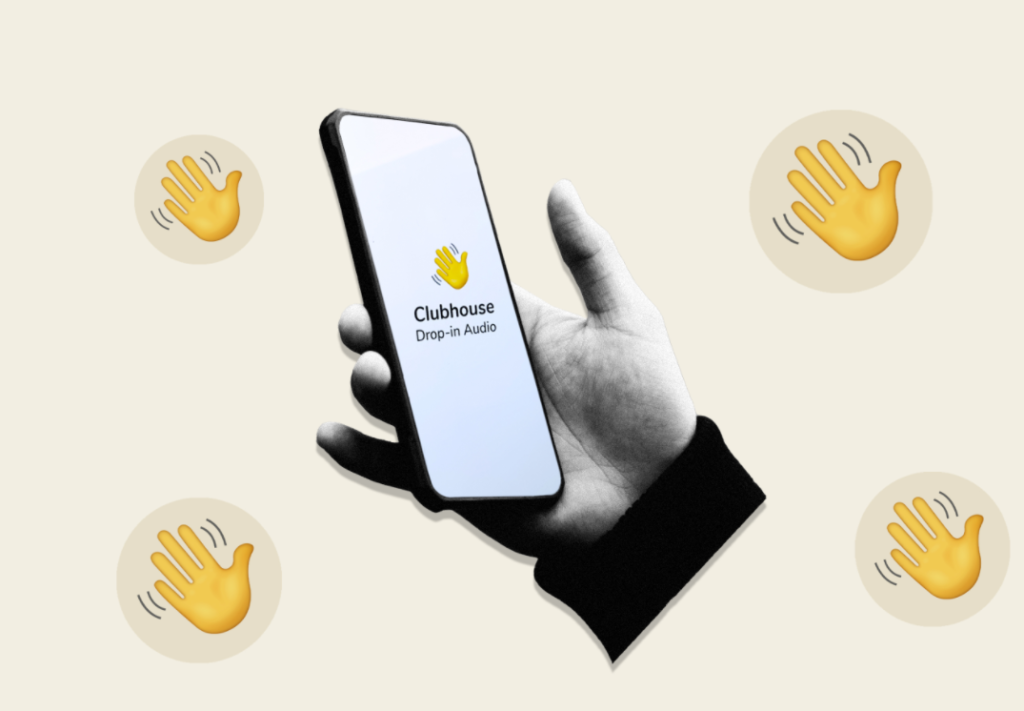
This is a stylized illustration, not a photo from real life. On a beige background, a black-and-white hand in a dark sleeve holds a smartphone. The screen shows the app’s splash screen: a yellow waving hand and the words “Clubhouse, Drop-in Audio.” Around it, four similar waving-hand emojis sit in round medallions.
The waving hand is the app’s own sign, which is why jokes about it often feature the greeting gesture.
What Clubhouse is
The app was created by entrepreneurs Paul Davison and Rohan Seth. It launched on iOS in March 2020. The main idea was “rooms” where people talk only by voice, like a live radio broadcast, with no video and no text feed. Listeners could come and go, and moderators invited people who wanted to speak onto the stage.
Access was by invitation: a newcomer had to be invited by someone already registered. The Android version appeared only in May 2021, and on 21 July 2021 the invitations were scrapped and the app was opened to everyone. While access was restricted, media reports say invitations were even put up for sale.
Peak popularity
The real boom came in early 2021. Well-known people appeared in the rooms, and names such as Elon Musk and Mark Zuckerberg were mentioned. Downloads over two weeks in February grew from 3.5 million to 8.1 million, and the company’s valuation reached four billion dollars in April 2021.
At the time, the app was discussed as a possible new form of communication. People looked for invitations, traded them and bragged about whom they had heard in the rooms. The status of “I’m already in there” became a joke in itself.
Why interest faded
By the end of February and the beginning of March 2021, the audience, according to analysts, began to shrink. Several reasons are cited. One is that listening to a live broadcast is harder than reading a feed or watching a recorded video, because you have to set aside time. In addition, similar features appeared at competitors, and the ability to join without an invitation stripped the app of its aura of exclusivity.
The memes captured exactly this contrast: first an “elite” club, then an ordinary app that people barely remember. The joke is about the rush toward what is fashionable and the rapid cooling of enthusiasm.
Caption examples
“Me when I finally got an invite to Clubhouse.” A caption for the picture with the waving hand: the joy and solemnity of the moment.
“Clubhouse now.” The same frame, used for a forgotten app: the same hand now looks like a farewell.
“My friends are discussing Clubhouse rooms, and I still haven’t figured out how to get heard there.” A joke about a newcomer’s confusion.
“The Clubhouse invite was worth more than the startup idea.” Hyperbole about hype, where access matters more than content.
How to use the template
The picture suits jokes about trendy services, tech fads, invitations and enthusiasms that cool quickly. Captions with two moods work best: excitement at the start and irony at the end. Do not attribute made-up scandals to the service, and do not name specific people unless the caption actually concerns them: the hand in the picture is anonymous, and the joke is about the app, not about people.