Who gives the order and who must answer
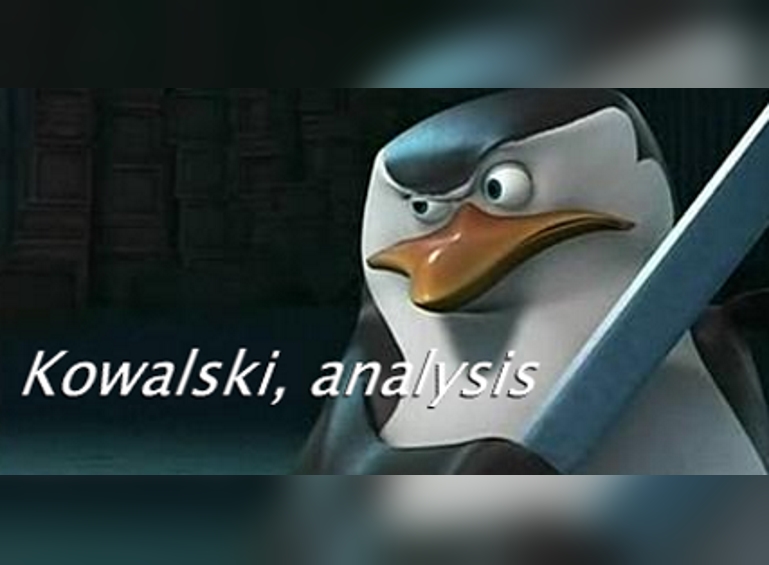
Skipper leads a team of four penguins; Kowalski handles calculations and technical explanations; Rico and Private complete the team. So a short command immediately distributes roles: one notices the problem and demands a report, the other has to figure it out. The meme picture shows Skipper himself, although the title contains the name of his subordinate.
The line appears in the 2014 feature film “Penguins of Madagascar,” in a scene where the squad ends up captured. The commander keeps his usual manner of leading even in an unpleasant situation. In the joke, this supplies a ready-made intonation: instead of a bewildered question, the person solemnly assigns someone an analysis, as if a whole intelligence team were standing right beside them.
Why the phrase and the picture have different sources
The common frame of Skipper comes from the opening of the television series “The Penguins of Madagascar.” It is not the same moment from the feature film in which the command is spoken. Combining the image and the text creates a new scene: the viewer reads the caption as though they are hearing the character’s line right now.
In this version, a close-up of Skipper is supplemented with the English text “Kowalski, analysis.” There are blurred stripes at the sides, and a metal strap is visible at his chest. The composed expression on his face reinforces the team’s seriousness. Kowalski is not in the frame — his presence is implied by the phrase itself. This explains why the request for analysis reads even without an image of the whole team.
How the team became an online reaction
One of the early known examples of pairing this caption with the frame was posted on October 22, 2018, by user Diamorphine330ml in the Reddit community r/dankmemes. The date refers to the internet joke, not to the creation of the cartoon or the television opening. The turning of the line into a template happened after viewers had already become acquainted with the characters.
In later variants, a text of a task or a separate picture was placed in front of Skipper. Sometimes the background was changed so that the commander seems to be studying the object presented to him. The short line outlived the image: it can be written in reply to a message, leaving the other person in the role of Kowalski. The character’s name then stands for a conditional specialist who must explain the noticed oddity.
A serious report on an unserious problem
The main comic difference lies between the gravity of the delivery and the ordinariness of the subject. A military team fits a penguin adventure, but it looks like an exaggeration when one needs to make sense of a store receipt or work out why a cat sleeps next to a new bed. Skipper makes a small puzzle look like an emergency.
The line can carry other shades as well. If the original message is genuinely unclear, it expresses a request for help. If the contradiction is obvious, the order becomes an ironic pause before the answer. And when the picture is deliberately meaningless, the very hope for a rational explanation is funny. The right intonation therefore comes from a pair: the situation presented and the commander’s reaction.
New reasons to call Kowalski
One could come up with the caption “The instructions have three steps, and seven parts are left on the table. Kowalski, analysis.” The specific numbers give the viewer a small mystery, while the team pictures the determination to turn furniture assembly into an investigation. Another variant: “The cat rejected the expensive bed and moved into its box.” Here one has to explain a preference that seems illogical to the owner.
One more example: “The app says I’m offline and at the same time sends me an ad.” The wording names the contradiction, and Skipper asks for it to be sorted out. These situations are invented to illustrate the template. A short reply in a chat works in a similar way: a familiar team adds a character’s voice to a question for which one would still like a clear report.