What is in the picture
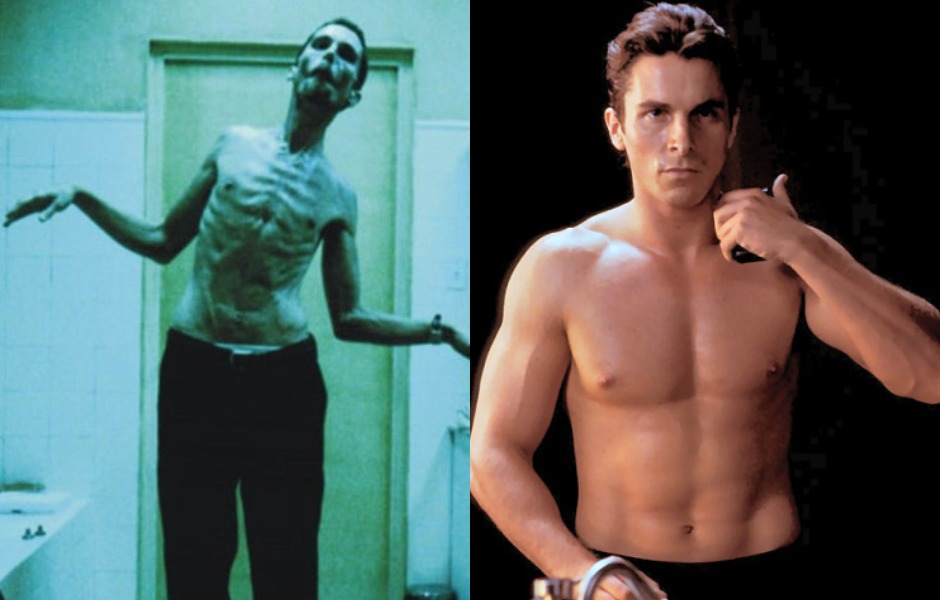
On the left is a cold blue-green color shot: a thin man stands in a white tiled room in front of a door, arms spread out, ribs and collarbones sharply visible, trousers hanging from his hips. On the right is a dark studio portrait of the same actor, shown shirtless with defined muscles. He holds an electric shaver at his neck and looks into the camera.
The composition is a classic "before and after," but the order is reversed: on the left extreme thinness, on the right an athletic body. The gap between the frames creates a vivid sense of incredible contrast.
Where the two photos come from
The left frame is from the 2004 psychological thriller The Machinist, in which Christian Bale played a factory worker suffering from insomnia. According to various reports, for the role he lost about 28 kilograms (around 62 pounds) and reached a weight of roughly 54 kilograms. His diet was reportedly extremely meager, and the weight loss was halted over concerns for the actor's health.
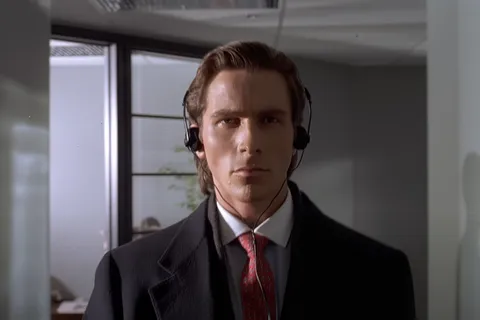
The right shot resembles a promotional still from American Psycho (2000), in which Bale played Patrick Bateman. The exact source of this particular photo is not known, so it is safer to say only that it shows the same actor in athletic form. Later, before playing Batman in Batman Begins (2005), he reportedly gained considerable mass again, and this rapid change of physique stuck in the public's memory.
Why it became a template
The joke relies on an absurd extreme. An ordinary person who decides to get in shape changes slowly and rarely reaches the result; Bale, across two photos, seems to demonstrate both limits of what is possible. The contrast is so large that it fits any exaggeration.
The template is often used to show oneself in different periods: "before vacation" and "after vacation," "on Monday" and "on Friday." The key is that the caption describes not health or a diet but a mood: the comic swing between expectation and result.
Caption examples
The captions sit in two slots: the left frame shows a "weak" or exhausted state, the right a strong or inflated one. A few invented variants follow.
"Me before payday" on the left and "Me after payday" on the right. A joke about a sudden change in budget.
"Phone at 1 percent" on the left, "Phone on the charger" on the right. An image of a nearly exhausted resource and its recovery.
"My weekend plan" on the left and "What actually happened" on the right. The values can be swapped here, depending on the irony.
"Exam session, week one" and "Exam session, the day before the exam." Fatigue and a sudden burst of energy can go in either order.
How to use it and what to keep in mind
The meme is best received in a self-deprecating tone: when someone talks about themselves or everyday situations. Do not use it to mock someone else's appearance, weight or diet: real weight loss can be linked to illness, and in Bale's case it was work on a role. Jokes should be built around the character's image, not around another person's body.
Pay attention to the order of the frames. The left half is read as "what was," the right as "what became." If you want the reverse logic, label each part explicitly, or the viewer will read the joke backwards.