What the image shows
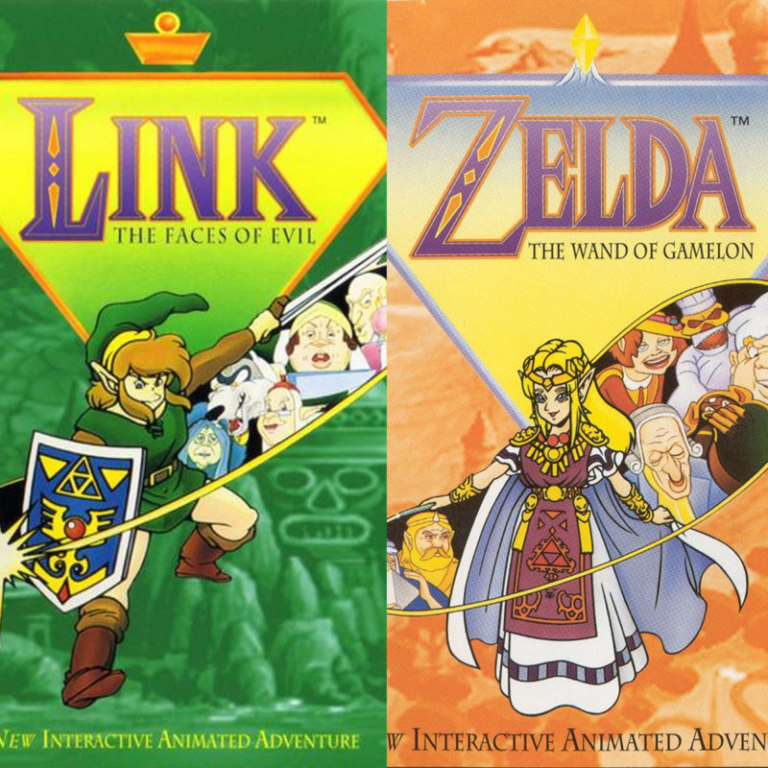
The picture is made of two covers. On the left is a green one: a large inscription “Link: The Faces of Evil” and, below it, the phrase “New Interactive Animated Adventure”. Link, in a green cap and tunic, swings a sword and holds a blue shield with a gold pattern, while around him, inside an oval, crowd the faces of other characters: elderly, rosy-cheeked, grimacing.
On the right is an orange-yellow cover with the inscription “Zelda: The Wand of Gamelon”. It shows Princess Zelda in a light dress with a purple cape and gold ornaments, with long blond hair and a tiara. Behind her, other heroes are gathered in the same oval. Both covers share one style: bright flat colors and a large logo whose letters look like carved stone.
How these games came about
Both games came out in 1993 for the Philips CD-i console. Development was handled by the studio Animation Magic, and they were published by Philips Interactive Media. It was an atypical story for the Zelda series: Nintendo and Philips ended their joint work on a CD drive, and Philips gained the right to use several Nintendo characters, among them Link, Zelda and Ganon.
The studio was founded by Igor Razboff and Dale DeSharone. According to the company's own accounts, it brought in animators from Russia for the animation: after the country opened up, this helped make the cutscenes cheaper and more competitive. Details of contracts and working conditions in open sources differ, so it is best to leave it at that.
From bad reputation to jokes
Critics panned the controls, the stiff animation and the voice acting. Reviews often cite the games as an example of how a franchise can be ruined. But there were also defenders, who believed many verdicts were passed without anyone really playing the games.
A new life began in the mid-2000s, when the clips became the main material for YouTube Poop. Who first uploaded the scenes and what year mass interest began cannot be established: sources give different dates, and the wave spread gradually. In 2020, according to reports, more than two hundred amateur animators joined forces to redraw about twenty minutes of cutscenes from both games.
Why the clips are funny
YouTube Poop is a montage of other people's videos, where lines are repeated, slowed down, sped up and shuffled. It needs material with expressive pauses and awkward delivery, and the CD-i clips are ideal: faces change in jerks, mouths open out of sync, and lines like “Gee, it sure is boring around here” are delivered with hopeless seriousness.
Some characters became standalone memes, such as the merchant Morshu and the wizard Gwonam. Fans also redraw the scenes in good quality, turning a bad game into a source of good-natured jokes.
Captions for the covers
“When someone on the project said ‘let's make it fast and cheap’ and this is what they brought.” The cover is presented as a benchmark for what results when ambition and budget don't match.
“My parents: ‘Back in my day, they had real games.’ Their games: [image].” The caption builds on the contrast between pleasant nostalgia and obvious disappointment.
“All the Legend of Zelda games are masterpieces. These two: well, at least they're funny.” Here the joke relies on the series being recognizable to the viewer.
“Drew it from memory in school in five minutes: Link.” The comparison to a child's drawing doesn't insult the author; it emphasizes the artless style.
Keeping the meaning intact
The jokes work well only if the viewer understands that these are side games, not main entries in the series. That is why it's worth mentioning CD-i in the caption, or at least the word “old”. Keep the tone good-natured: the games have long since become a subject of affectionate fan humor rather than harsh criticism.
The left and right covers can be used separately. The green one, with Link swinging his sword menacingly, suits captions about pointless heroism; the orange one, with Zelda and a crowd of heroes behind her, suits stories about a company that has gathered and doesn't know why.