The scene players recognize
The Elder Scrolls V: Skyrim came out in 2011. At the start the hero comes to on a cart being taken to execution along with other prisoners. One of them addresses him with the words “Hey, you. You're finally awake,” that is, “Hey, you, you've finally woken up.” Russian-language captions usually render the line this way. Everyone who started the game has seen this scene, so the line is recognized from the first words.
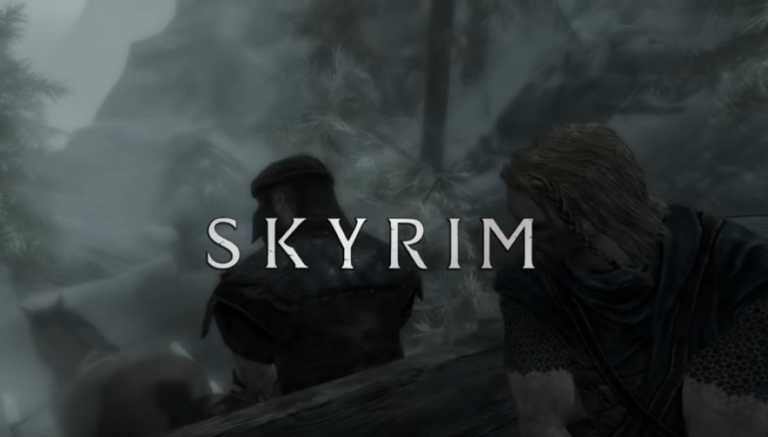
The frame in the collection shows the title card with the SKYRIM logo against fog and a snowy slope. In the center a person in a dark hat is seen from behind; on the right at the edge is a figure with light braided hair and a scarf, looking off to the side. The logo immediately tells the viewer which game the scene comes from.
How the title card got into videos
The meme is built on an insert: before the main content of a video or message, a fragment from the beginning of the game plays, and only then does the ordinary material start. The exact dates of the first such clips could not be established, but the trend spread noticeably in the late 2010s.
The game's long-lasting popularity and its release on new platforms also play a role, so the scene is known both to those who never played and to those who have finished it many times. Every viewer recognizes it in a second.
Why the insert looks like an ad
What's funny here is the collision of two expectations. The viewer expects an ordinary start to a video and gets a cold road, fog and a familiar voice. The abrupt change of tone resembles an ad break that interrupts a conversation mid-sentence.
Behind this is a joke that the game is supposedly forced on everyone. The humor lies not in the game itself but in where it was placed: the character wakes the viewer as abruptly as an ad does, and that is the main device.
Once the insert became widespread, recognizing the scene took a second. The viewer knew what would come next and smirked in advance: the strength of the joke was defined by the speed of recognition, not by the text.
Examples of captions
Below are three invented captions. Each uses the same phrase in a new situation.
A video about bathroom renovation, with the insert at the tenth second: “Hey, you, you're finally awake. Now let me explain how to lay tile.” The intro from the game becomes a transition into an ordinary lesson, and the irony rests on the contrast.
A reply to a message sent last Thursday: “Hey, you, you're finally awake.” The phrase sounds like a mild reproach: it describes the delay, not the person.
“Promised to play Skyrim five years ago. Hey, you, you're finally awake.” The caption itself becomes a call to start, and that is the point of the “ad.”
How to use the frame
The frame suits short replies, when someone is late answering, or an intro to a video where the transition should be noticeable. It's best to trim the scene to the needed second rather than insert the whole episode: that keeps the joke clear.
If a static picture is needed, the caption is best placed over the lower part without covering the logo: it is the logo that explains where the scene comes from. Captions on serious topics look strange: the template works on light irony.