A screen role and a meme image
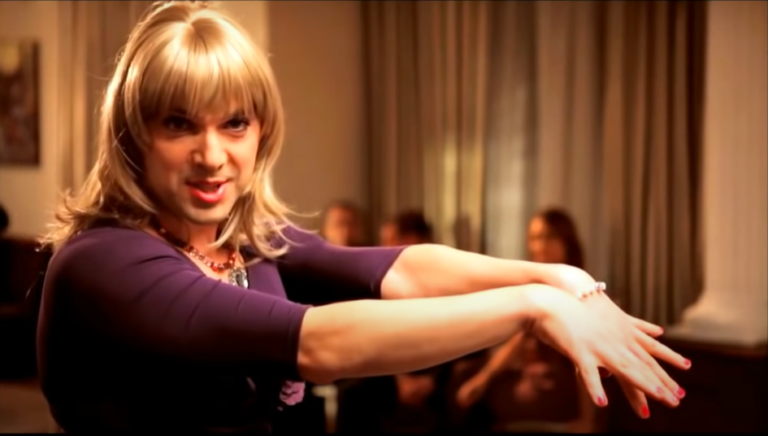
In the image, a man in a light wig and a purple dress poses with his arms spread wide. The image is tied to Alexey Arestovych and his role as Lucy Zaitseva in the Ukrainian comedy Don't Be Afraid, I'm with You (2012). This is a staged performance, not a documentary shot of private life, and not grounds for drawing conclusions about the actor's gender identity. The stage costume and the gesture create a deliberately flamboyant, almost musical image.
In 2022, Arestovych became widely known as an adviser to the head of Ukraine's Presidential Office and a media commentator. The old shot began circulating alongside his public appearances, and the nickname "Lucy Arestovych" stuck. It links the real person, the character he played, and current political controversy. Not every image captioned with that name necessarily refers to the same scene, or even the same work.
Why the contrast is funny
The comedy comes from a jarring reframing: the viewer suddenly sees a serious political commentator in a bright stage costume. A caption can make a serious statement read like a line from the character, or, conversely, turn the old shot into commentary on the news. Reposts often strip away the original filming context, so the viewer gets not a full scene but a striking fragment whose meaning is created entirely by the new caption.
The meme shows how a person's earlier work takes on new meaning as their public profile grows. The shot itself predates Arestovych's political fame, but audiences started reading it through the current news cycle. The template ranges from a good-natured reminder of his acting career to hostile political mockery. Satirical text is more convincing when it criticizes public statements and actions rather than using appearance or a theatrical role as an insult.
Meaning and use
The format suits pairing two incompatible images: "at the meeting — an expert, in the old film — a pop diva," "meant to give a dry report, ended up with a musical number." Sometimes the picture simply marks an unexpected transformation, or a moment when a familiar person reveals an unfamiliar side. Without political context, it reads as an ordinary reaction to contrast. But attached to a news item, the caption can create the impression that the shot relates to a current event.
New everyday captions might be: "Me at the interview / me a minute after being asked to tell them about myself" or "Was going to go to bed early / remembered I have a presentation tomorrow." These turn the joke on the user rather than inventing lines for Arestovych. The meme montage doesn't confirm any facts and says nothing about a person's relationships, orientation, or character. Criticism of public activity should be kept separate from speculation about private life.
Satire and the limits of fact
The nickname spread in a politically polarized environment. One user might see the shot as an in-joke, another as criticism of a media image, a third as outright insult. So a single picture doesn't have one fixed reading. If the meme accompanies a news item, it's important not to replace a discussion of what was actually said with mockery of an acting past. The shot was filmed as part of a staged production, even if the new montage makes it look like topical commentary.
What can be verified are the earlier acting work and the later public fame, but a particular meme-maker's intent and judgment are interpretation. A caption can express a position, but it shouldn't be passed off as a quote or a biographical fact. Only two facts are verifiable — the role of Lucy Zaitseva in the 2012 comedy and Arestovych's subsequent fame as an adviser to Ukraine's presidential office in 2022 — while the tone and political aim of any particular meme depend on the caption its author adds, not on the shot itself. Further checking of the exact source might clarify the episode, but that wouldn't change the overall context of the image.