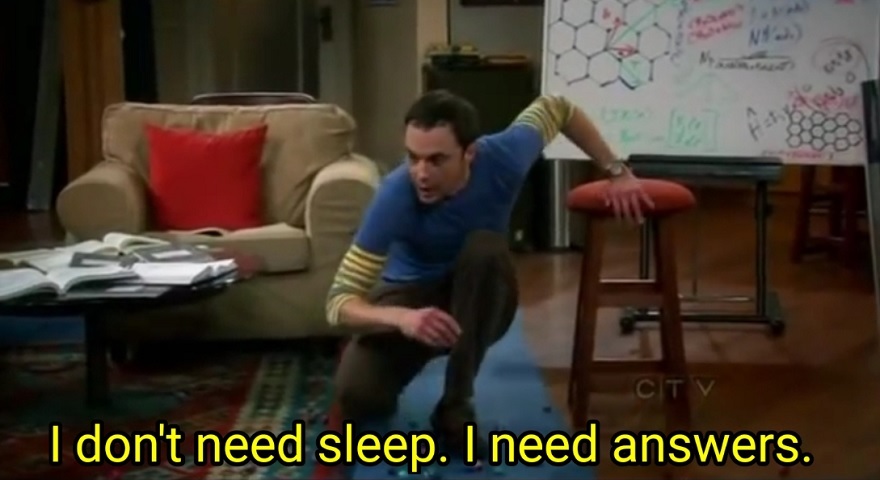
The episode and the line
The line reportedly comes from the episode “The Einstein Approximation” in the third season of The Big Bang Theory. It is spoken by Sheldon, one of the main characters, a physicist with a pedantic personality.
The frame shows a man in a blue T-shirt with yellow stripes on the sleeves. He has crouched on the carpet next to a stool, one hand resting on its red seat. Behind him is a white board covered with drawings and formulas; on a coffee table to the left lie books, and in the background a red cushion sits on an armchair. The English caption is written in yellow letters at the bottom of the frame, and the broadcaster's logo is visible in the lower right corner. His half-turned pose creates the feeling that he is speaking to someone who is not visible in the frame.
How the line became a reaction
The image with this line became an online reaction in the 2010s: at first fans of the series shared it, and then it spread beyond the fandom. Exact dates of the first remixes and popularity figures are not given here, because they could not be reliably confirmed.
The format is simple: one line and one recognizable scene, so it is easy to adapt to any topic. The shorter the caption, the better, because the line already carries the entire intonation.
What the reaction means
The line works as self-irony. Formally, the character says he doesn't need sleep because understanding things matters more. The joke lies in the reversed priorities: the person clearly hasn't slept, yet demands answers. The pause between “sleep” and “answers” is what makes the joke: viewers recognize in it the habit of thinking until morning.
It is important to separate the character from the actor who plays him. The joke is about the habit of searching for explanations, not about the personal life of the actor who plays the role. For that reason, captions are better built on the situation rather than on anyone's biography or appearance.
Caption examples
Below are four variants written for this picture. In all of them the line comes at the end, as a conclusion to a short story.
“The deadline is in an hour, and there's one error in the spreadsheet that nobody sees. I don't need sleep, I need answers.” The specifics at the start give weight to the late-night panic, and the final line turns it into a joke.
“The cat stares at me at four in the morning and says nothing. I don't need sleep, I need answers.” A companion who explains nothing turns ordinary insomnia into a small detective story, and the line sounds like a demand addressed to the cat.
“I was asked to explain the tax system in one evening. I don't need sleep, I need answers.” The mismatch between the size of the task and the deadline makes the line funny: the character gives up sleep for a result that will not appear anyway.
“The kettle boiled, but the coffee jar is empty. I don't need sleep, I need answers.” Here a trifle sounds like a serious problem, and what is funny is that the drama is the size of a kettle.
When the picture fits
The template suits stories in which a person stubbornly looks for an explanation instead of sleeping. It works well when the caption is short and the cause is out of proportion to the search. Long explanations weaken the effect, because the line itself already carries the entire intonation.