A trip request ends with the word Sleep
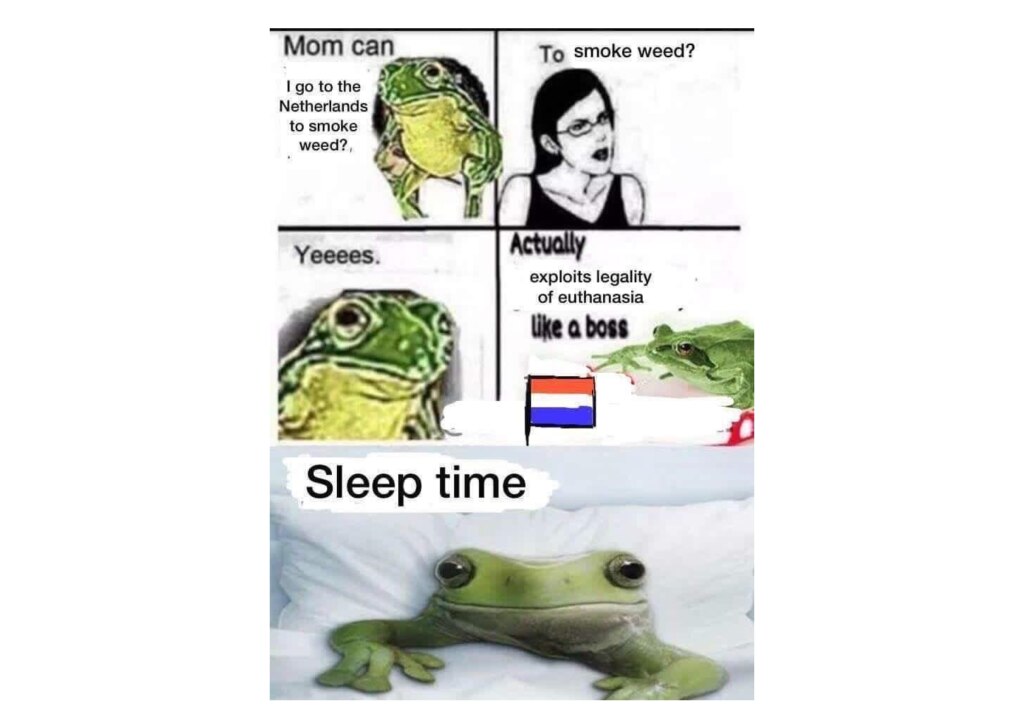
The picture begins with four panels of a familiar dialogue. The frog asks his mother whether he can go to the Netherlands to smoke weed; the woman asks back whether he really means smoking, and the character cheerfully confirms it. In the next frame the promise turns into an unexpected statement: he supposedly plans to use the legality of euthanasia, and a Dutch flag is placed beside him. The caption “Sleep time” and a separate image of the frog on a white pillow turn the comic into a deliberately black joke about death disguised as a bedtime scene.
In the usual template, each line sets up the twist: the request sounds innocent, the mother's agreement confirms the literal reading, and the last panel reveals that the character intended something entirely different. Here the familiar deception is combined with Dutch geography, the word “legality,” and a sleepy ending. The visual shift from small blurred frames to a large photo of the frog changes the pace: first you have to read the dialogue, then the picture sets the literal “bedtime” next to the euthanasia just mentioned.
From a fan request to a rage comic
One of the earliest dated traces of the template goes back to August 8, 2012: a user from the One Direction fandom, @THENJHQ, posted a version in which the character asked for money to buy the band's merchandise. This does not prove that this particular post was the absolute first use of the drawing, but it shows an early form of the joke: the mother asks what the money is for, the son agrees, and the reader sees the hidden plan. The original appeal of the format lay in the simple conflict between a promise and a real desire.
In 2013 a Tumblr remake with hay bales became widely shared, and in 2015 a variant in which the hero planned to buy “The Communist Manifesto” circulated on the same platform. From then on, the recognizable sequence was no longer tied to fan merchandise: almost any unexpected purchase could take its place. Later versions often kept the characters' facial expressions and lines, changing the object of desire and the final panel.
From “Like a Boss” to the absurd “time”
In 2017 a heavily compressed, “fried” version spread, in which a request for money for a burger ended with the purchase of heroin and the phrase “Like a Boss.” That remake shifted the humor from a secret everyday desire to a provocative, deliberately inappropriate jump. In June 2018 the format was crossed with “Soup Time,” and in the fall an evolutionary branch about animals and mutations appeared. By then “____ time” had already become a separate closing blow: such an ending seemed to give the absurd outcome the name of its own event or activity.
The Evolution Can You Give Me Wings subcategory moved the same scene into a conversation between an animal and evolution: the creature asks for a mutation, receives it, and then the final panel shows a strange consequence and names it “bird time” or another play on the species name. This is not a separate storyline with a fixed moral, but a relative of the original scheme of request, agreement, and unexpected application. In the Sleep Time version, the frog and the sleepy ending use that freedom for a far darker conclusion.
Invented endings with “time”
A study-themed variant: “Mom, can I have a tablet for my notes?” “For notes?” “Yes!” And in the final panel the hero opens a Pomodoro timer and gets “Focus time.” For a trip: “Can I have a ticket to the next town?” “To visit grandma?” “Of course!” The panel shows the hero at a concert entrance with the caption “Encore time.” For a pet: “Can I have a storage box?” “To tidy up your things?” “Yes!” The last scene shows a cat inside the box with “Box time.”