Origin
The exact author of the comic and the place of its first publication are unknown. The meme dates to 2015, and that period coincides with the heyday of two-panel comics on the Russian-language internet, where captions were written by hand or typed up in simple editors. The name took hold in two variants: "the wise monk" and "sensei," with the second reflecting the character's Eastern styling. Early copies were often redone by hand, so versions of the same comic differ in font, border, and the wording of the caption, though the overall scheme stays the same.
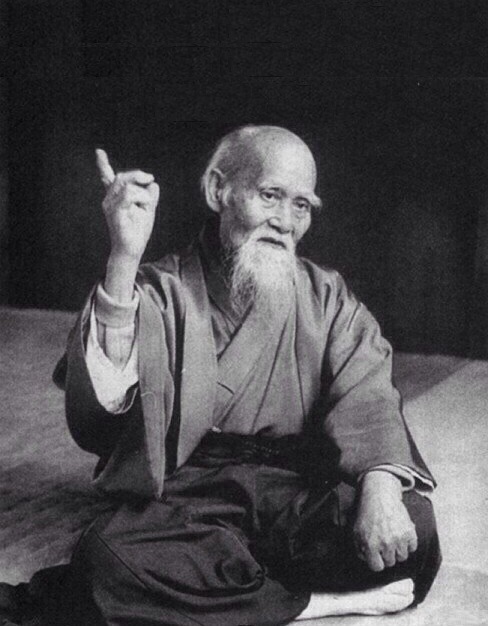
The character's image appears to be based on an actual photograph of an elderly master in a traditional Japanese kimono, sitting on the floor with a raised hand. According to a common attribution, the person in the photo is Morihei Ueshiba, the founder of aikido. Using this image for a comic is a typical move: a real, elderly mentor is cast in the role of a generic sage, and the audience perceives him as a symbol of Eastern philosophy rather than as a specific individual. That's precisely why the character in memes is almost never linked to the biography of the person shown in the original frame.
Structure of the joke
The comic consists of two panels. In the first, the character, looking solemn, formulates a piece of advice while drawing on the external image of a sage: slow speech, a raised finger, a calm pose. In the second panel it becomes clear that the advice is harmful, absurd, or outright stupid. The contrast between the tone and the content is what creates the humor. It matters that the first panel has to look convincing: if the absurdity is already visible there, the effect is lost, so the authors try to keep the serious tone right up to the very last moment.
The "bad advice" genre is well known: these are jokes about how to act wrongly, delivered with an air of authority. The sage figure fits this device perfectly, because the expectation from him is a correct answer. The more serious the delivery, the more noticeable the absurdity. That's why the comic reads as a parody of giving advice in general, rather than of any specific person. The reader fills in the meaning themselves: one phrase is enough to understand that what's in front of them isn't wisdom but a caricature of it.
Spread
The meme spread through pictures on social networks and themed communities, where comics were valued for their short delivery. It was easy to rework: the line would change while the sage figure itself stayed recognizable. That's why variants with different pieces of advice can be found online, each working by the same scheme. Users often saved the picture and republished it with new text, while the old captions gradually faded from memory.
In conversation, the line from the comic is sometimes retold as an ironic recommendation. A person invokes the "wise teacher" to justify an obviously bad idea. This usage shows that the meme became not just a picture but also a way to jokingly respond to other people's advice. In comments under news stories and posts about everyday life hacks, the comic often appeared as a short reply to an overly confident claim.
Cultural context
The meme illustrates a broader trend in late-2010s Russian-language humor: the Eastern sage as a type used in jokes about worldly wisdom. The image carries over from films, cartoons, and books, and online it's often turned on its head. In comics like this, the joke isn't aimed at criticizing the philosophy itself but at the genre of giving advice. Over time the sage figure became a universal symbol of authoritative advice, and users turn to it when they want to poke fun at an acquaintance's overly confident advice or at a typical line from family conversations.
In this way the meme turns from a specific comic into a general linguistic device. It's understood without explanation, which is exactly why it stays comprehensible even to those who've only glimpsed the original picture in passing.