A punishment that always starts over
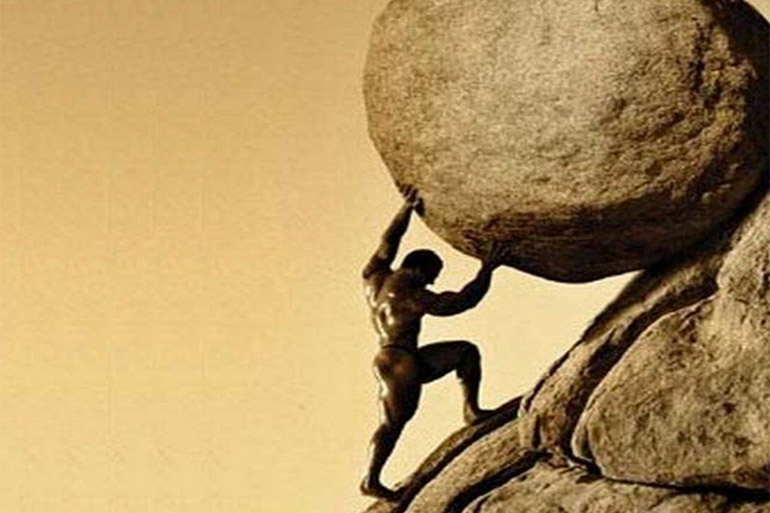
In ancient Greek myth, Sisyphus cheated death and was punished in the underworld: he must roll an enormous boulder to the top of a hill, but it slips and tumbles down before the job is ever finished. Ancient authors tell the backstory in different ways, but the repeated effort is the core of the image. The picture in the catalog shows exactly this recognizable motif: a small figure straining against a boulder bigger than itself.
In the twentieth century the philosopher Albert Camus used the story in his essay "The Myth of Sisyphus" to talk about the absurd and human existence. His closing line asks us to imagine Sisyphus happy, and it is often quoted next to internet memes. It does not mean, however, that everyday hardship should be endured cheerfully. Camus is reflecting on how a person relates to repetition and to the lack of a final answer.
The motif of pushing a boulder is older than any internet template. Images of Sisyphus were used in artistic and political comparisons long before digital culture. In 2023 short videos picked it up again as a joke about routine, workouts, and attempts at self-improvement. So the date of one popular video is not the date the whole theme originated.
Work with no finish line
In the everyday version, the boulder is a job that can never be closed for good. You wash the dishes, and soon there are more; you clear your inbox, and new emails pile up; you fix a file, and someone creates three more copies. The joke lands best when the caption names a recurring task and the image shows a disproportionately heavy effort. The viewer feels not only the tiredness but also the lack of a final result.
You can deliberately change the attitude toward the hero: "Sisyphus after his fifth workout is already waiting for the next set," "the boulder rolled down again, but at least I kept my pace." This contrasts with the bleaker reading. The format does not require the joke to be hopeless: it allows for perseverance, routine, sarcasm, and friendly support. The caption sets the meaning, while the myth supplies the basic situation.
An ancient myth in digital life
Early internet versions of Sisyphus existed long before short videos, but the template changed along with platforms and audiences. The image was paired with text about an eternal chore, redrawn with modern characters, and then the rolling boulder was moved into game and TV scenes. More philosophical versions add Camus; simpler ones carry a caption about work that won't be done by evening. Not every meme with a boulder quotes the philosopher.
The image in the collection is static, has no embedded text, and does not let us identify the illustrator. Do not attribute it to a particular ancient vase, painting, or sculpture without evidence. It is enough to explain the recognizable mythic motif and separately describe what happens to it in the modern format. That keeps the history accurate and leaves room for viewers' own interpretations.
How to come up with your own boulder
Put a task that keeps coming back in place of the boulder: weekly laundry, filling in a report, cleaning up after a pet, moving old files into a new folder. For example: "I delete temp files, and my apps create new ones"; "I closed all my tasks, and the calendar refreshed." The more precise the recurring detail, the more recognizable the link. Don't call every difficult goal pointless: in the original myth, it is the impossibility of finishing that makes the punishment special.
If you want to stress hope, show Sisyphus not as a winner but as someone who keeps going even though he knows the boulder will fall. If the topic is real burnout, a single image may sound too bleak; add a supportive caption or choose a different reaction. The myth works as an image of cycles, but people's experiences don't have to fit into one metaphor.