Two windows and one line
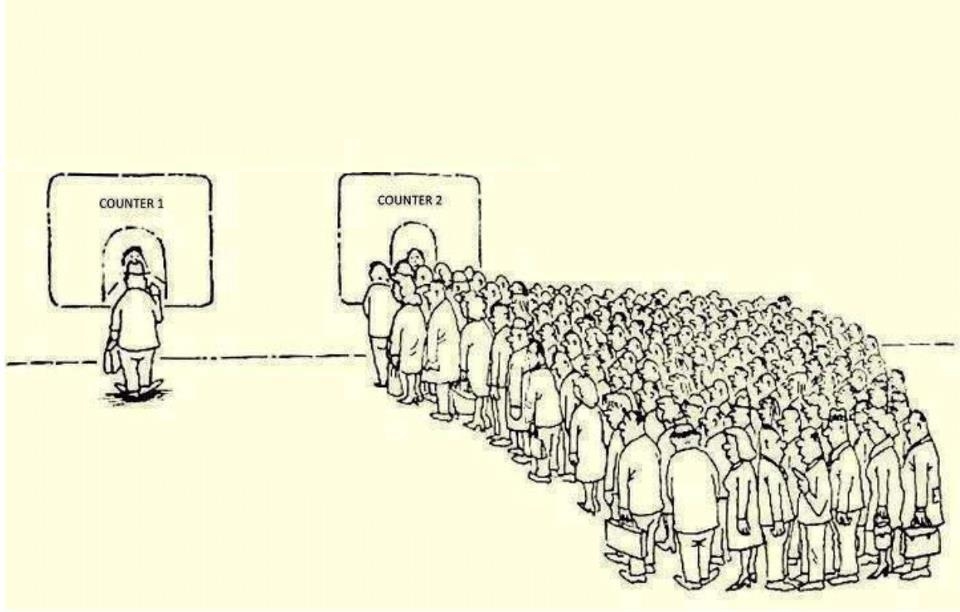
The drawing shows a hall with two service windows. Above the left one is written COUNTER 1, above the second COUNTER 2. At the first window stands one person with a bag, and no one is nearby. At the second window a line stretches from the window across the foreground and off the right edge of the frame.
The drawing is done in black outline on a pale yellow background. The figures are indicated with short strokes, faces are barely visible, and all the people are alike in style. There is no explanatory text inside the drawing itself, so the meaning of the windows is set by the caption in a given version.
What is known about the history
The author of the drawing is not identified, and the exact date of its first publication is not reliably confirmed. According to reports, the earliest known traces date to the early 2010s. This matches the period when comics with two options and standard captions were actively remade on forums.
The original meaning of the drawing also remains a matter of retelling: it is often said that the line forms at the window that serves “those who have no time,” while the lone visitor stands at the window for those who are in no hurry. There is no reliable confirmation of this particular arrangement, so it is better to assign the roles yourself in the captions.
How the template spread through communities
The template quickly became a universal form for comparing two tastes, habits, or behaviors. One of the early popular topics concerned music: one version contrasted popular genres with rock and metal. Later the comic was adapted by anime fans, gamers, and fans of TV series and cartoons.
A feature of the format is that the drawing requires no knowledge of context: the scale of the line and the emptiness at the neighboring window are read instantly. That is why it is so easy to transfer to any topic where there is a majority and a rare exception.
Captions that rest on the lone figure
Example 1: above one window, “Watching the series to the end”; above the other, “I'll watch the series when I have time.” The line describes everyone who plans to rest later, and it is funny because the lone person has clearly chosen calm.
Example 2: “People who read the instructions” and “People who figured it out themselves.” The captions flip expectations: the line looks like the majority, and one person looks like a rare case, and the viewer compares these numbers.
Example 3: “I know how Wi-Fi works” and “Restart your router.” What is funny is not the number of people but the question each one asks the window: one asks simply, the other waits for a complicated answer.
Example 4: “Who made it before lunch” and “Everyone else.” A short caption sets the scale in one word, and the line becomes clear without any extra explanation.
Why the picture is funny without a caption
The main joke is the difference in scale. One person at the window looks almost like an empty spot, while the line runs beyond the edges of the drawing, and the viewer does not need to read the text to understand the situation.
The template suits topics with two patterns of behavior. The division must be clear: if both sides look the same, there is no contrast. That is why captions work better when they emphasize a difference in habits rather than in people.
It is better to keep the captions short and symmetrical: two windows, two phrasings of the same length. If the left caption is longer than the right, the viewer first reads it and loses the sense of proportion between the loner and the crowd.