A photo with a date that doesn't match
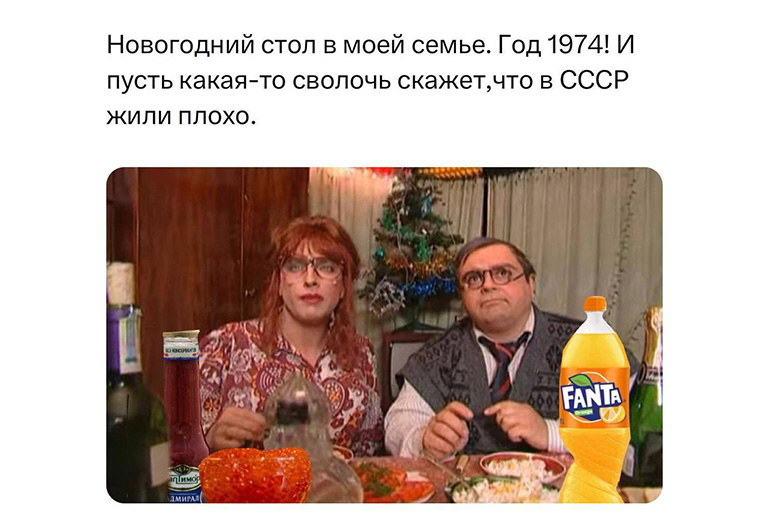
The local picture combines a photo of a festive table, text about 1974, and a noticeable logo of a carbonated beverage. The post claimed that this was how New Year was celebrated in the USSR and that people lived badly. Users quickly noticed the mismatch: items and arrangement in the composition don't match the stated time. As a result, the argument was not about the quality of the salads but about how easy it is to pass off a modern staging or collage as archival evidence.
The photo itself is not a reliable historical document. In publications from the time the post circulated, the illustration of the table was identified as the work of the artist Marcello Corti; beside it there are also drink graphics that are clearly not part of an original household photo. It's important to state the conclusion carefully: exactly this presented collage doesn't confirm what a New Year's table looked like in a specific Soviet family in 1974. The meme doesn't prove that any similar table or memory is fake.
Nostalgia as a checkable story
Such a post uses the familiar form of an elder's story: "it was simpler back then," "this is how we lived," and "compare it with today." When behind this phrasing appears an image with details incompatible in time, the nostalgic tone itself starts sounding like a joke. The viewer notices a gap between an authoritative date and visual clues that contradict it.
Reworks usually mock hasty generalizations: they turn one picture into proof that an entire era was happier or poorer, showing how easily a neat caption confirms a conclusion readers already hold. It's useful to separate the specific photo, its date, its disputed author, and the added drink-logo collage from broader memories of the past — the meme doesn't require pitting generations against each other.
Examples of captions about memory and archives
Under the image you could write: "Found a family photo from 1988: a postcard from 2022 in the background." Here the joke rests on the same mismatch but doesn't attribute false memories to real people. Another example: "An archival school lunch shot—the date on the caption is older than the smartphone that took it." The sequence of details gives away an overconfident description.
For family chat: "Grandma's cake recipe from 1974: ingredients added in 2026." Such text jokes about memory that accumulates new details. If the author has a real old photo, it's better not to edit it in a way that changes its historical meaning. You can use the meme format for self-irony while keeping the original photo and clearly marking where the joke starts.
Don't substitute facts with collective mockery
The meme suits criticism of questionable dating, false nostalgia, and digital collages, especially when the mismatch is visible right on the image. It can serve as reason to check the origin of a photograph: who took it, when it was first published, whether modern objects were added on top. This approach turns a funny mistake into a small media literacy lesson.
Don't use a separate composition to declare all stories about the past false or mock people for personal memories. The history of a specific picture is already quite expressive on its own. A caption should distinguish between incorrect dating and broad conclusions about life in the USSR. And if the origin of the table image isn't established, you shouldn't pass assumptions about the author or the location as confirmed fact.