Forest, snow, and a shovel
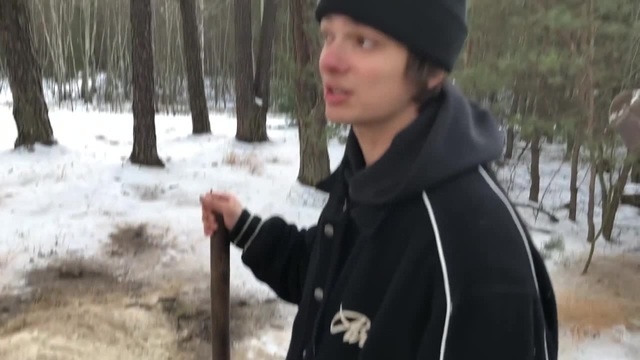
This is a frame from a video, not a ready-made template with text. A winter forest with thin tree trunks, the ground covered in snow mixed with dark soil. At the center stands a young man in a black knit hat and a dark jacket with a white stripe on the sleeve; he's turned his head and is saying something. In front of him, the handle of a shovel is planted in the ground. The frame is blurry and handheld, so the face isn't clearly visible.
The strike that actually gave the meme its name isn't visible in the frame: we're seeing the moment before or after it. That's why the picture is used more as a hint at the whole scene than as a standalone joke.
What's known about the video
According to accounts, the video was posted on the YouTube channel Optimus Gang. In the sketch, one participant hits another with a shovel while shouting "Nyukhai bebru." The earliest appearance of the phrase online is dated to 2018.
The phrase became widely popular later: a notable surge of interest hit in the fall of 2020. This distinction matters: the filming and posting date to 2018, while the popularity dates to 2020. The video's participants usually aren't named — the meme runs on the line, not on the identity of the person in the frame, and information about them is scarce.
What 'bebra' is, and why it can't be explained
There's no single interpretation of the word. Some guessed it was Ukrainian slang, but there's no confirmation of that version. Others have suggested a distorted form of "bobyor" (beaver), or a German town with a similar name that has nothing to do with the meme. If the word was invented for the sketch, then it's simply a string of sounds that happens to sound funny enough.
The meaning of the phrase is purely situational: "get lost," "you're not getting anything," "tough luck." It's not an insult in any real sense, because nobody knows exactly what's being offered to sniff. Hence its mildness: it's used as a joke rather than in a real quarrel.
Captions for the picture
Below are made-up examples.
"Friend: you're retaking my strength-of-materials exam for me. Me: go sniff a bebra." The unexpected request and the blunt but harmless refusal make it work.
"An app sends a notification: you have 3 days left of your trial. Me, getting out a shovel." Here the shovel from the picture functions as the response to pushy advertising.
"A coworker at 5:55 on a Friday: I have a quick question, just five minutes." Caption: "Go sniff a bebra." The contrast between the office setting and the forest clearing creates comic absurdity.
"I suggest we go dig at the dacha this weekend. Everyone: go sniff a bebra." The shovel in the frame hints at a gardening theme.
In all these examples, a request or pressure comes from someone, and the response is the short line. If the request is too serious, the joke stops working.
How not to misuse it
In a chat, the phrase alone is enough without the picture; the frame is needed when you want to show that the refusal is a joke. The shovel makes the picture suitable for stories about manual labor, the dacha, construction, or shoveling snow, while the forest background suits replies in the spirit of "go away."
The frame shouldn't be captioned as if it depicts real violence against a specific person — in the original it's footage from a sketch. A short caption of two or three words works best; the rest is carried by the picture and the line itself.