A profile that read like a comic
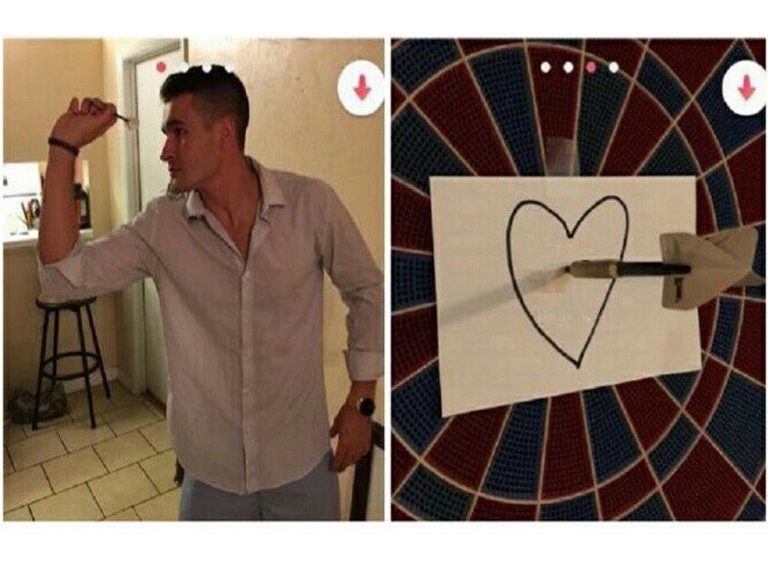
In March 2017, Twitter user Natalia, under the handle @rllynatalia, shared photos from a Tinder profile. The young man was presented as Jared. His set consisted of four consecutive images: preparing to throw, the action itself, a heart-marked target and a look directed at the camera. Instead of independent portraits, the result was a finished scene that a profile visitor uncovered by swiping through.
The concept was built on a deliberately simple romantic gesture. Darts provided a ready model of a hit, the paper heart turned a sports target into a love target, and the sequence showed success. The series did not need complicated filming or a special location. Its appeal lay in performing a familiar metaphor with one's own hands, using an ordinary home target.
What remained in the two panels
In the first frame, the young man in a white shirt with rolled-up sleeves raises his hand holding a dart. The second shows a dartboard with a sheet bearing the outline of a heart pinned to it; the dart is already sticking into it. At the top are the dots of the Tinder photo sequence and download icons. The juxtaposition of these two frames preserves the beginning and the payoff of a longer series.
There is no moment of flight here. The viewer connects preparation and result through the structure of the collage, rather than watching a continuous recording of the throw. That is why the character's confidence is part of the staging; the image by itself does not show how many attempts it took. For the meme version this is not essential: the paper heart is needed as a clear sign of a successful impact, while the sports score stays outside the story.
Who turns out to be the shooter
In the captions, roles change easily. The guy may stand for an author who has decided to win over another person, or for the conversation partner whose words hit the narrator's preferences exactly. The heart stands for the object of affection, while the dart stands for a well-timed reply, a shared interest or a small gesture. One outcome can fit different causes, as long as there is an understandable emotional link between them.
The joke often exaggerates how quickly a feeling arises. Instead of a long acquaintance, everything is decided by one unexpected detail: a coincidence of tastes, an attentive reply or an offer to meet that was long desired. The conventional target makes this detail visually precise. The comic hit does not describe the real feelings of a stranger; it shows how strongly the author of the caption wants to present their own reaction.
Three hits without a real dart
For example, a narrator suggests going somewhere over the weekend, and the conversation partner unexpectedly chooses a small museum that he has long been meaning to visit. Her suggestion becomes the dart, and the heart is his delight at the matching interest. For this variant, no words about beauty are needed: what proves attractive is a concrete idea of doing something together.
In another invented scene, a person complains that they keep forgetting the title of a book. A new acquaintance guesses exactly that book from a few strange details of the plot. The hit expresses joy at attentiveness and a shared reading experience. The more whimsical the description of the lost book, the more convincing the sudden accuracy of the answer appears.
A third example could accompany the message "I also like tea without sugar and with very strong brewing." A trivial taste match is presented as a decisive romantic argument. The scale of the romantic gesture is deliberately larger than the everyday reason. It is this exaggeration that links the new captions to the original profile: a small coincidence receives the effect of a perfectly thrown dart.