What's in the frame
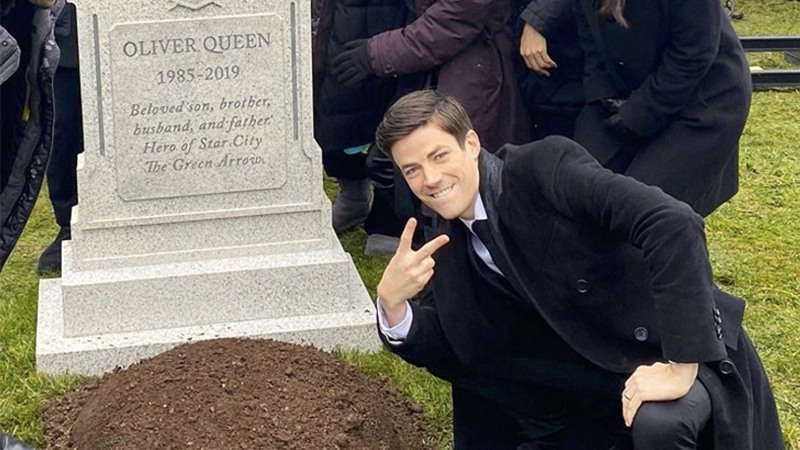
In the foreground stands a light granite headstone with the inscription: “Oliver Queen, 1985–2019. Beloved son, brother, husband, and father, Hero of Star City, The Green Arrow.” In front of it is a small mound of fresh earth. Right beside the headstone, a smiling man in a black coat, white shirt and dark tie is crouching: his left hand rests on his knee, and his right hand is raised to his face in a two-finger “V” sign. Behind him stand people in dark jackets.
The emotion clearly doesn't fit the place: a broad smile and a playful pose in a cemetery scene.
Where the picture comes from
The photo shows Grant Gustin, who plays Barry Allen, the hero of the series The Flash. The shot was taken on the set of Arrow during the show's final period, when the character played by Stephen Amell, Oliver Queen, had already died in the storyline. Arrow itself aired on The CW from 2012 to 2020.
The photo was posted on Instagram on January 28, 2020, by actor Echo Kellum, Gustin's co-star on Arrow. The image quickly spread to Reddit and other platforms and, within a few days, had become a template.
What the joke is
The meme rests on a mismatch between scene and emotion. A cemetery and a headstone signal grief, while a smiling pose and a victory sign signal triumph. Translated into joke terms: something has ended, and the hero is delighted about it.
Importantly, there is nothing malicious in the photo itself: it's a film set and an actor's playful behavior behind the scenes. That's why in memes the image is more often used for light gloating over a situation than for mocking a real loss.
Moreover, the meme barely requires any knowledge of the show. Viewers need only the words on the stone and the smiling person beside it, and the scene reads instantly. This explains why the image spread far beyond comic book fans: it has been used in discussions about technology, sports, studies and work.
Try reading the inscription on the stone as part of the caption: the dates “1985–2019” and the hero title give the picture an almost documentary seriousness, and against that backdrop the cheerful pose looks even more absurd.
How it is used
A typical setup: on the left you describe something that has “died” or ended (an old service, a tiresome job, a previous version of a program), and the caption shows the joy of the survivor. The device is often applied to technology and games.
A self-deprecating variant also works: “I'm at the funeral of my bad mood.”
Caption examples
“I'm standing at the grave of my old phone, which has finally died.” The joy of having an excuse to upgrade the gadget.
“Us, when the competitor's server went down in the middle of the big sale.” Gloating over a rival's failure.
“Fans, when the show got cancelled after a disappointing season.” The caption adds a touch of argument.
“Me, when the report I turned in ate my Saturday: now I'm free.”
Tips
Caption the picture with situations where the “end” applies to things, programs and plans, not to people: the grave in the frame is playful, but jokes about real losses easily come out crude.
Don't attribute real statements to the actor: the picture relates to filming, not to his opinion about the hero's death.