Who is where in the frame
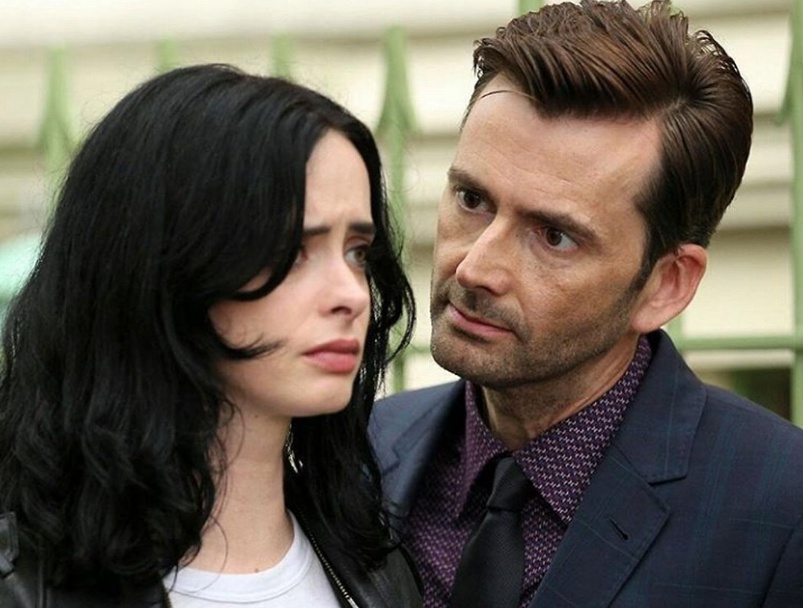
On the left is a woman with wavy black hair, in a dark jacket and white T-shirt: she looks away to the side, her face tense. On the right and slightly behind her is a man with combed-back chestnut hair and stubble, in a dark blue jacket and a dark shirt with a small light pattern. He stands almost right up against her and looks at her from the side, his head slightly tilted. Behind them is a blurred green fence.
This is a still from the Marvel series “Jessica Jones”. The heroine is played by Krysten Ritter, and the villain Kilgrave by David Tennant. Which exact episode the frame comes from is not asserted here: sources online give different information.
Why this scene became a template
The series itself is about a woman with superpowers who survived psychological abuse at the hands of Kilgrave, a man who can subjugate people’s will. The meme, however, barely uses this plot: it was pulled out of context and turned into a universal image of “someone too close”.
Reportedly, as a caption template the picture began spreading on English-language platforms around 2019–2020, and then moved into the Russian-speaking internet. The exact date of the first use is hard to establish.
How the joke works
At its core is the scheme “an object and its persistent observer”. The man is given the caption of an object or phenomenon that insistently reminds of itself, while the woman gets the caption of the one trying not to notice it. The lack of space between the faces makes the relationship feel heavy: the character on the right doesn’t just look, he looms.
Importantly, the characters’ emotions hardly carry over into the meme, but the uneasy background remains, so the joke suits situations with mild awkwardness or pressure rather than warm topics.
An additional nuance: the heroine’s face doesn’t express fear in the usual sense, but rather tired endurance. Thanks to this, jokes about intrusive thoughts and intrusive obligations come out more precise than jokes about real danger.
Caption examples
First example: on the left “me”, on the right “the alarm clock I snoozed for five minutes”. Here the alarm looms over the hero: the pressure builds and is unavoidable.
Second example: on the left “a person trying not to buy anything in a store”, on the right “the sale on the thing I’ve needed for ages”. The meaning is a temptation one cannot look away from.
Third example: on the left “my plan for the evening”, on the right “unread emails in my work inbox”. The looming figure turns into a reproach.
Fourth example: on the left “a cat that wants to sleep”, on the right “an owner with a phone and a camera”. A light intrusion into personal space reads instantly and without extra words.
How to use the template wisely
Assign the two figures by role: the one who wants to turn away, and the one who doesn’t take their eyes off. Usually short captions are placed right on the picture, or written in two lines above it.
Do not apply the template to real people, especially when it comes to actual stalking or pressure: the original story is one of abuse, and such a caption can hurt. Safe topics are everyday life, habits, temptations and deadlines.