What is visible in the frame
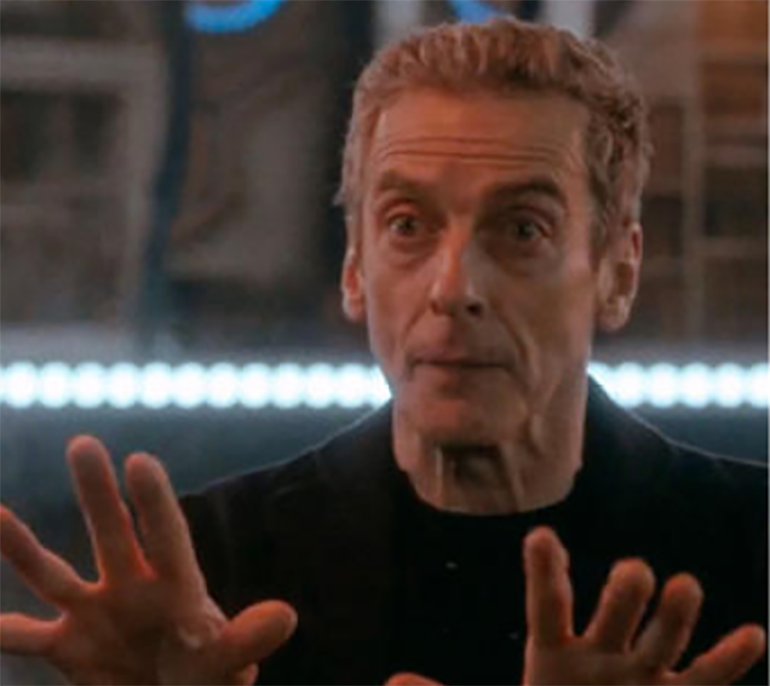
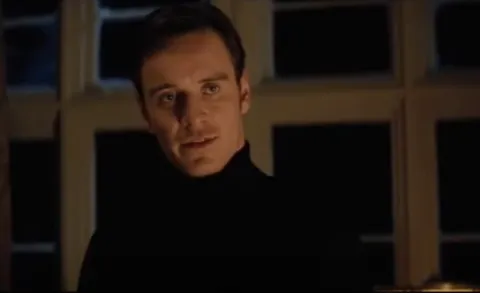
A close-up of a man with short light hair, in which gray is visible. He wears a dark jacket over a black turtleneck. His eyebrows are raised, his eyes wide open, his lips slightly pressed together, like a man about to say something important but not very pleasant.
Both hands are raised toward the viewer: fingers spread, palms facing forward. This gesture reads both as “wait” and as “it's not that simple.” Behind him is a blurred background with a bright stripe of white lights. The image is small and blurry, so in the template it is the gesture and facial expression that work, not the details of the setting.
The joke that never happened in the series
Doctor Who has been airing since 1963, and its main character is a time traveler who changes appearance. This Doctor is played by Peter Capaldi. Which exact episode the frame came from could not be reliably established, and this does not hinder the meme: what matters is not a plot scene, but the fact that the frame was used as an illustration for someone else's line.
The line itself came from elsewhere. Reportedly, it started with a post on the Yik Yak app from April 13, 2016: to the question “Is four a lot?” someone replied “It depends on context. Dollars, no. Murders, yes.” In May 2019, an Instagram account posting fictional quotes from Doctor Who turned this exchange into an image, and on June 12, 2019 it was posted to Reddit, where it gathered tens of thousands of upvotes. After that, the formula started being adapted to any numbers and situations.
How the formula works
The classic structure has four beats. First, a question is asked that can seemingly be answered with a number: “Is thirty a lot?” Then comes a calm “It depends on context.” Next is the first context, harmless and carrying a “no.” And finally the second context, which flips the meaning and gives a “yes.”
The humor is carried by intonation: the answer sounds dry, like a lecture, even though the content is often absurd or sinister. The Doctor's gesture adds the necessary seriousness. The shorter the first context and the more unexpected the second, the stronger the effect. If both options sound equally plausible, the joke disappears: it hinges on a sharp turn.
Caption examples
“Is forty browser tabs a lot? It depends on context. For a workday, normal. For a single borscht recipe, cause for reflection.” The first context justifies the number, and the second shows how little it takes to end up with such a mountain of tabs.
“Is it early to get up at five in the morning? It depends on context. For sunrise in the mountains, no. For a message ‘Are you there?’ from your boss, yes.” The contrast works because the first case is beautiful and the second is everyday and unpleasant.
“Is it a lot of spoons of sugar in tea? It depends on context. One, a habit. Four, already jam with tea.” Here the second option is simply exaggerated, and that is enough.
“Is waiting three days for a reply long? It depends on context. From a pizza courier, yes. From a bank, lightning fast.” The joke rests on the fact that expectations of different organizations have long since become a genre of their own.
How to use the template
It suits questions about quantity, time and distance, as well as arguments where each side has its own scale. The caption is best made as a short dialogue: the question on top, the formula and two contexts below. Long texts break the rhythm.
The facial expression is non-aggressive, so the meme fits both friendly chats and discussions of work trivia. Don't use it where a direct answer is needed: the template itself mocks evasiveness, and in a serious conversation it will come across as dodging the topic.