From three polygons to Ourfoodgon
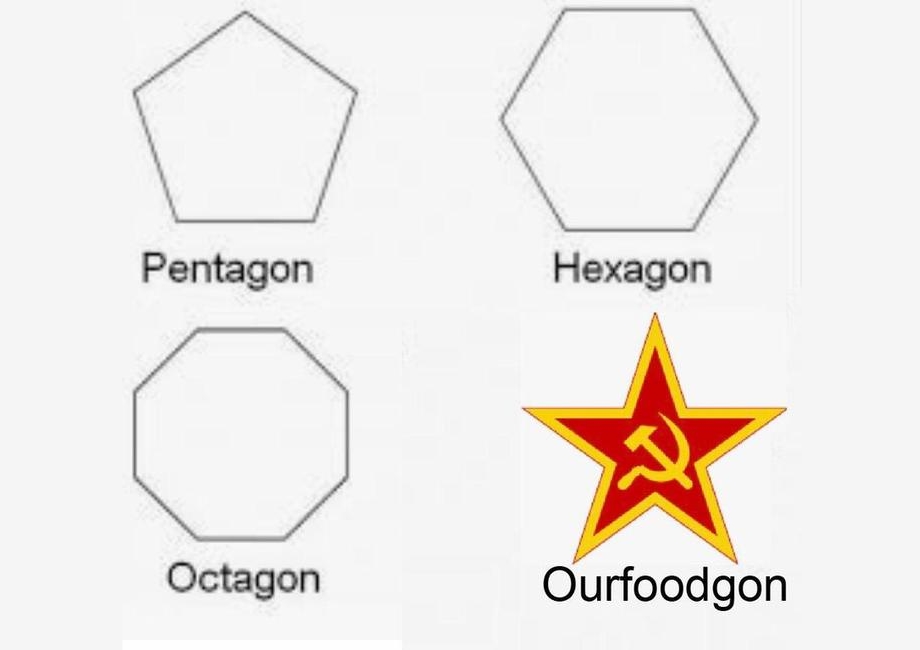
The image has four equal panels. The first three show outlines of a pentagon, a hexagon, and an octagon; the English captions Pentagon, Hexagon, and Octagon highlight the shared ending sound. The fourth panel abruptly changes register: instead of another shape, it shows a red sign with a five-pointed star, a sickle, and a hammer, and beneath it the word Ourfoodgon. This is not a continuation of a geometry lesson but a deliberately absurd finale in which a familiar set of sounds is attached to an emblem. The clash between the tidy row and the unexpected symbol is what makes the joke in this particular version.
The list sets up the expectation of a familiar form: after five, six, and eight sides, you expect another polygon. Instead an emblem appears that combines a star with symbols of Soviet power. The caption Ourfoodgon blends the English “our food” with the familiar ending of shape names. The last element thus moves the joke from geometry to the image of collective ownership: membership in the row is determined by sound, not by the number of corners. The black outlines on the white background make the sudden red ending stand out even more.
Oregon and early dated copies
The format has an early branch with the same sound trick: after Pentagon, Hexagon, and Octagon, Oregon is added to the row. The name of the American state rhymes with the shape endings, although it has nothing to do with geometry. Online archives preserve dated versions of this image from 2016, but accounts of the specific early publication disagree: some records point to FunnyJunk, others link the version to Memedroid. So these traces show that the pun was already in use at that time, but they do not by themselves prove where it first appeared or who made the very first macro.
On April 1, 2017, the Oregon version was posted to the Reddit community /r/dataisbeautiful, and on July 22 it appeared on /r/funny. The difference between the names of the communities adds its own irony: in the first, the image pretends to be a clear presentation of data; in the second, it becomes a standalone joke. All four cells keep the same structure: a drawing above a caption. Thanks to this, the state's map can be slotted into the same row where the mathematical shapes once stood, without changing the composition.
Porygon and other offshoots of the row
The version with the Pokémon Porygon keeps the same framework but turns the ending into a reference to the character. Chronicles date the publication of this version differently: one gives March 14, 2017, another February 19, 2018. So the substitution was already in use in those years, but a specific post date cannot be considered settled. Later, users substituted words and phrases ending in “-gone,” intensifying the English play on sound and the meaning of disappearance. In October 2018 the format again spread on Reddit: alongside simple substitutions, thematic and deliberately absurd continuations appeared.
A notable stage of the autumn wave was a Reddit post from October 21, 2018, with a reference to the song “Take On Me” by a-ha. The drawn-out ending of the line was remade into “I'll Be Gone” and placed next to the geometric names. Here the last panel no longer simply replaced a shape with a picture: it brought to mind the sound of a song. The format linked the drawing, the reading, and a familiar melody, so its continuation could be a whole phrase rather than just an object with a suitable name.
Invented continuations of the row
Invented continuations can rest on a word that unexpectedly fits the ending by sound, without mixing languages. For example: “Pentagon, hexagon, octagon, dragon”: a fairy-tale creature wedges itself into the list of shapes. “Pentagon, hexagon, octagon, van”: an ordinary vehicle keeps the ending sound without using an English word. “Pentagon, hexagon, octagon, moonshine”: an everyday object closes the row with an unexpectedly down-to-earth rhyme.