A comic champion from Bubble Gang
Boy Pick-Up appeared on the Filipino comedy show Bubble Gang. Ogie Alcasid plays a contestant in a competition of pickup lines: his character behaves like an unbeatable master, though he utters strange and deliberately incoherent phrases. The sketch combines the idea of a pickup dialogue with the presentation of a verbal battle. Viewers laugh at the mismatch between the performer's confidence and the quality of what he says to the supposed love interest.
In an April 2012 interview, the show's participant Eri Niman said he had proposed the idea of the competition itself, while Alcasid came up with the champion. Niman played Boy Back-Up, a loud supporter who admired his lines. That same year the character got a standalone film, Boy Pick-Up: The Movie. By May 2012 a description of the internet template had already appeared, noting its spread on a Russian-language forum, then in other countries and on 9GAG. The name of the first author of the picture has not been established.
A pose after an imagined triumph
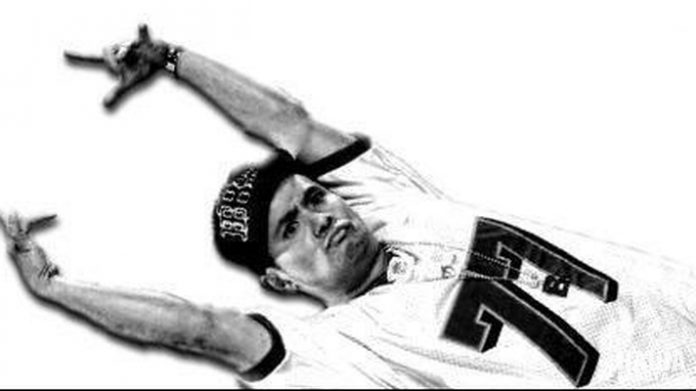
The image is black and white. A man in a cap turned backward tilts his head and torso sharply to the side. On a light sports jersey, the number 77 is printed large. Both hands are raised near his head, with fingers forming ostentatious gestures. The frame contains no interlocutor or dialogue text: it shows only a showy finale to the performance, as if the hero is already sure he has made the desired impression.
Such an angle makes it possible to use the portrait as the last panel of a comic. The preceding lines create an attempt to get acquainted, and the image puts a visual full stop after its failure. Even without multi-panel editing, the gestures look like self-congratulation. The contrast is especially strong when the caption delivers a banal or obviously inappropriate line: the hero displays a triumph that the content of the conversation does not deserve at all.
Failure declared a victory
The typical mechanism consists of anticipation and letdown. The start of the dialogue promises a witty compliment, sometimes built as a question or riddle. The reply should make the hero charming, but instead it turns into absurdity. The portrait does not acknowledge defeat: the character seems to invite the viewer to applaud. This is what distinguishes the template from a simple joke about an unsuccessful pickup, where the person is embarrassed or gets rejected.
In Russian-language remakes the TV character becomes a conventional author of an overconfident line. To understand it, one does not need to know the Filipino show: the sportswear, the tilted head, and the raised hands already convey showy confidence. However, the sketch's history explains why precisely the triumphant pose suits this format. The absurd lines were originally part of the comic persona, so the meme continues its principle, changing the language and the specific conversation.
Three new introductions
The first invented dialogue: “You're not by any chance a navigator?” — “No, why?” — “I'll take a wrong turn anyway.” The master's pose declares victory after the admission of one's own helplessness. In the second variant the hero asks: “Do you like riddles?” Having received consent, he replies: “Great, I don't know what to say next either.” The expectation of a prepared compliment collapses into emptiness, but the confidence on the face remains.
The third scenario: “How can I find you?” — “By name.” — “Great, I was going to ask for the fridge's address.” Here an out-of-place household detail destroys the romantic approach. These lines are invented and are not translations of Alcasid's sketches. They share one comic role: a person turns any outcome into his own success, and the expressive final frame lets the viewer see at once both his self-satisfaction and the real absurdity of the dialogue.