From an English phrase to an internet label
Pick me translates literally as "choose me." The phrase existed in English-language discussions long before it spread in short videos. In the 2020s, creators started acting out the image of a girl who emphasizes that she's "not like everyone else," sometimes at the expense of putting down other women. In the Russian-speaking internet, the word "pikmi" quickly became shorthand for this caricature.
The term has no single official definition. Its critical meaning is usually tied not to a specific hobby, outfit, or personality trait, but to the fact that a person builds their own appeal on comparison and devaluing others. Later the word started being applied more broadly — sometimes just to a girl someone happens not to like. This broadened its recognizability but made the label less precise.
What the visual template says
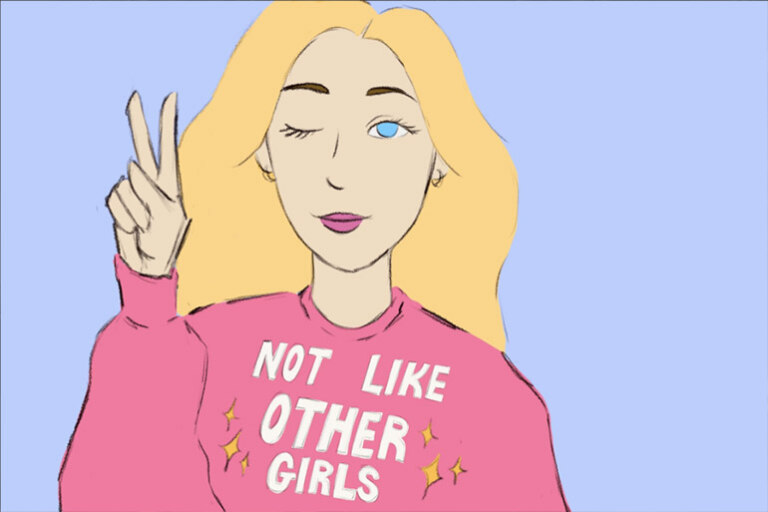
In the illustration, the heroine smiles and flashes a victory sign; the caption on her pink T-shirt proclaims her exceptionalism. This is a caricature drawing, not evidence of anyone's actual words. The contrast between the phrase and the confident pose is meant to instantly signal the type to the viewer. The image doesn't tell us that any specific woman actually thinks or behaves this way.
The familiar formula usually continues with an unexpected "proof": the character claims to be unlike everyone else, but offers an ordinary or deliberately odd explanation. The comedy comes from self-presentation that becomes excessive. But if the caption simply lists the character's interests without putting anyone else down, what we're looking at may just be an ordinary description of taste, not the satirical role itself.
A parody of comparison, not of interests
In its successful version, the meme mocks the pressure to constantly prove one's own exceptionalism and the habit of pitting women against each other. For example, a character declares herself "not like that" because she can calmly read through a coffee machine's manual. The twist might reveal that the manual didn't actually help, and the confident claim was overblown. The target of the joke is the pose, not the skill itself.
In comments, though, the word "pikmi" is often used for a girl simply because she likes sports, video games, certain music, or talking to men. Having an atypical interest proves nothing about her motives on its own. You can love football or wear comfortable clothes without trying to please anyone. So it's more useful to describe the actual behavior than to replace an argument with a trendy term.
Examples with a safe twist
"I'm not like the other departments: we started the meeting right on time." The next panel shows that the team's presentation won't open, so the triumphant claim quickly loses its scale. Here it's corporate bragging being mocked. Another example: "I'm not like other coffee lovers: I actually read the coffee machine's manual first." The result can again backfire, turning the boast into self-irony.
These transfers keep the template's structure while removing the gendered accusation. What matters is the shift from self-promotion to comic mismatch: the character announces a rare quality, and the proof turns out to be surprisingly mundane. If you want to joke about real behavior, a specific exaggeration is clearer and gentler than a blanket label the reader might apply to anyone.
How not to turn the meme into bullying
In public exchanges, the label can humiliate a person, especially when it's used against a girl for an ordinary choice or her appearance. In that kind of use, the satirical role disappears and the word turns into a judgment of her as a person. When retelling the meme, it helps to call the character fictional and stress that they're deliberately exaggerating a behavior. That helps separate the caricature from a judgment of women in general.
The template fits when everyone understands the context and the joke targets demonstrative comparison or absurd self-praise. If the goal is to discuss an actual conflict, it's better to name the specific words or actions. And conclusions about anyone's motives shouldn't be drawn from a single photo. The heroine in the picture is a fictional character; a real person deserves a more precise conversation than a meme label.