Where the detective came from
L.A. Noire, made by Team Bondi and released by Rockstar Games in 2011, takes the player to Los Angeles in 1947. Cole Phelps investigates crimes, gathers clues, and questions witnesses. In the original dialogue system, the player chose Truth, Doubt, or Lie: accept an answer, doubt it, or accuse the speaker of lying.
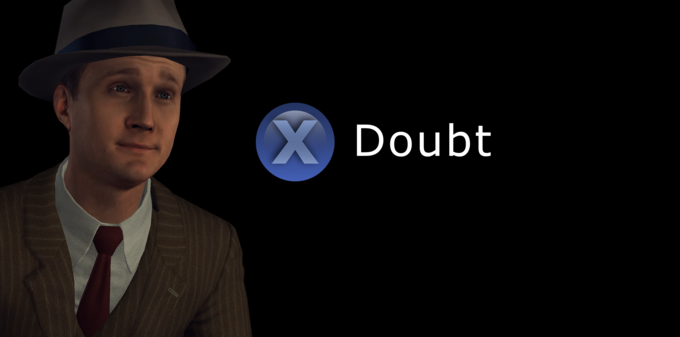
Doubt was a distinct way to conduct an interview. For example, the official game guide recommended it when a witness seemed suspicious but the detective had no immediate evidence for an accusation. After the choice, Phelps could press the witness for an explanation. The meme keeps a simple action from that system: hear a claim and press an imaginary doubt button, as if a conversation came with a game menu.
The command moved beyond the game
The earliest known uses of the image as a reaction date to late 2012. In a December discussion on Funnyjunk, someone posted it in response to a dubious claim; later it appeared in other threads as a ready-made objection. This is early documentation of the format, not a confirmed date for the creation of a particular edit.
By the middle of the decade, the short command was already being used in discussions of promises, news, and stories that readers did not quite trust. In 2016, deliberately long-winded remixes also circulated: the concise X Doubt was expanded into an elaborate description of the same doubt. The game response thus gained two comic modes: an extremely short reaction and a mock-scholarly paraphrase of a few simple words.
The face and the button speak together
Against a black background are Phelps’s portrait in a hat and suit, a blue circular X button, and the word Doubt. This is a composite image highlighting the character and the command, rather than a complete interrogation screen. His tilted head, tense gaze, and a slight upward turn at one corner of his mouth support the caption: the detective seems to have already heard a weak excuse.
The format differs from a direct accusation. The person posting the reaction offers no new evidence; the point is that the other person’s version sounds implausible. That makes the image an easy fit for bragging, a promise of an incredible result, or an improbably lucky coincidence. Sometimes it is aimed at their own words: someone announces they will go to bed early tonight, then answers themself with Phelps. The comic effect comes from the familiar gap between what is claimed and what is expected.
Invented reasons to press X
“I’ll watch one short video now and start cleaning right away.” Phelps becomes an inner commentator who knows the usual outcome of that promise. “The update will take no more than two minutes” is a tech-themed version: the screen seems to offer a choice between trusting an overly optimistic forecast and doubting it.
Another example: “This box isn’t heavy; it only has books in it.” The doubt comes before anyone tries to lift it, because the explanation itself gives a reason to question the claim. These captions are invented to illustrate the format. They leave room for the joke: they do not prove anyone is lying, but let the viewer recognize a familiar promise and mentally choose the matching line from the detective’s menu.