What the image shows
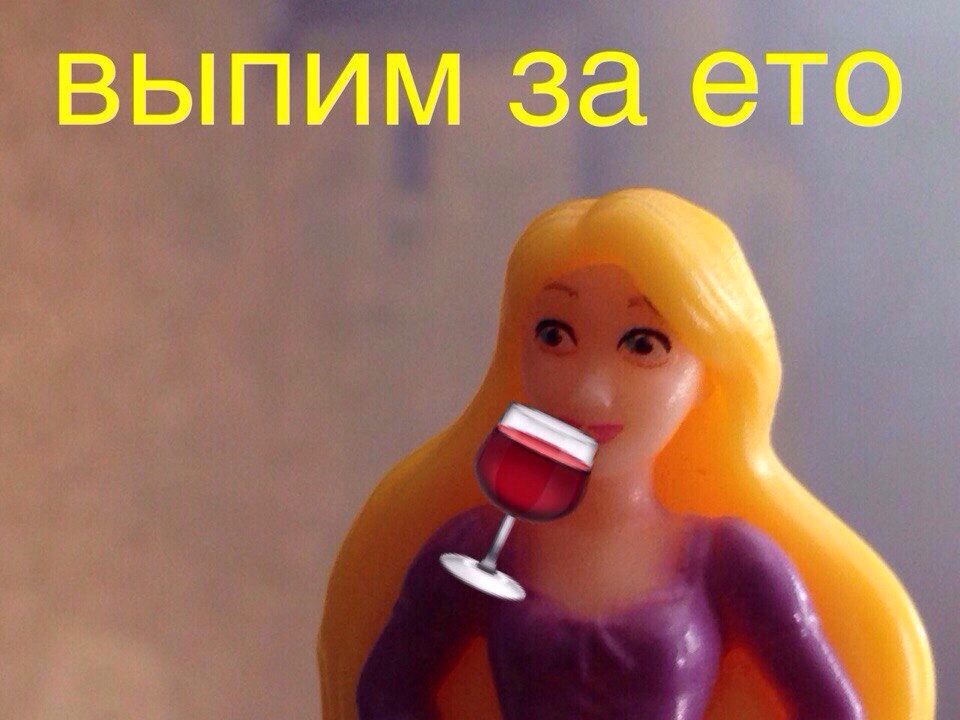
The photo is a close-up of a small plastic figurine: long golden-yellow hair, a purple dress, and a gaze turned slightly to the side. Next to her face, a red wine glass emoji has been drawn over the photo, so it looks as though the doll is about to drink. The background is blurred and in warm beige and gray tones, and the figurine fills the right side of the frame.
Across the top, in large yellow letters, it reads “выпим за ето” (roughly “let’s drink to this”). Both words are misspelled: “выпим” is missing a letter, and “это” has been turned into “ето.” The errors are deliberate and set the tone: they look like something typed quickly and casually, with no concern for the rules. What is funny is not the wine glass itself but the combination of a fairy-tale appearance and a homely toast.
Where the series came from
The origin of the “lalka princesses” series is not reliably established. Retellings mention a version in which the first pictures appeared on Russian social networks in the mid-2010s, but neither the date, the author, nor a specific source page can be confirmed, so it is better not to name them.
The word “лалка” is often linked to the internet laugh “лол” (“lol”), but this is more a guess than a proven etymology. The only firm point is that the genre of captioned figurines and dolls is recognizable in Russian-language internet culture and rests on a few stable devices that are easy to repeat without any special skills.
Why the mistakes are funny
The image of a Disney princess is built on politeness, a soft voice, and beautiful, bookish speech. When such a heroine declares “выпим за ето,” there is a clash of expectations: the viewer expects polished text and gets a line that sounds like it was said across a kitchen table.
The mechanism resembles a game of “wrong on purpose”: the word is written incorrectly, but the meaning is clear. The reader corrects the form in their head and sees the difference for a split second, and that difference is what makes them laugh. That is why the caption works better when there are only a few errors and they look natural, rather than like a random jumble of letters.
The joke targets the contrast of styles, not real people. The figurine serves as an intermediary: it allows people to laugh at a colloquial tone without addressing anyone in particular.
Caption examples
The examples below are invented for this template and are not quotes.
“давай за щастье, оно одно” (“let’s drink to happiness, it’s the only one,” with “щастье” misspelled for “счастье”). The toast sounds solemn, but one misspelling shifts the tone: the pathos turns into a joke about the toast itself.
“принц опять не пришёл, зато вино есть” (“the prince didn’t show up again, but there’s wine”). The fairy-tale pattern of waiting turns into an everyday story, and the contrast rests on the heroine being calmer than the plot would suggest.
“ну за понедельник, он всё равно придёт” (“well, here’s to Monday, it’ll come anyway”). The toast sounds almost like a threat, and it is the unexpected tone that makes people smile.
How figurine photoshops work
Recognizability matters for this template: the figurine should fill the close-up, and the caption should sit at the top, so the eye reads the text first and then the face. The background is better kept blurred, otherwise everyday details will distract from the joke.
The wine glass emoji added over the photo works as a visual cue for the toast. It can be swapped for another object if it supports the caption: a cup of tea for a morning text, or a phone for a text about messaging.
Do not put real names or photos of people onto figurines, and do not use captions that mock specific people you know. That keeps the picture a game with a toy rather than mockery of a real person.