What this meme is
“Sanya, give back the hundred” is an internet meme built on abstract humor: a short request-line is added to a picture that is often unrelated in meaning to the text. The phrase is addressed to an imaginary Sanya who supposedly took a hundred rubles from the speaker and is not returning them. In Russian-speaking internet slang, “sotka” is the colloquial name for the hundred-ruble bill, so the phrase itself is read as a domestic joke about debt and small change.
The catalog dates the meme to 2017 and places it in the category of abstract memes. This category groups images in which the caption deliberately fails to explain the picture, and the meaning arises from the mismatch between the text and the image. This device was common in Russian-speaking communities of that time, but the specific platforms where the phrase first appeared are not confirmed.
Origin
The origin of the meme is not established. It is not known who first wrote the phrase, in which community, or on which image it appeared. The mentions refer to individual user posts, but they do not explain the original joke.
The phrase became established as a recognizable reference and is used as a caption for images that have no obvious connection to money.
Image for the entry
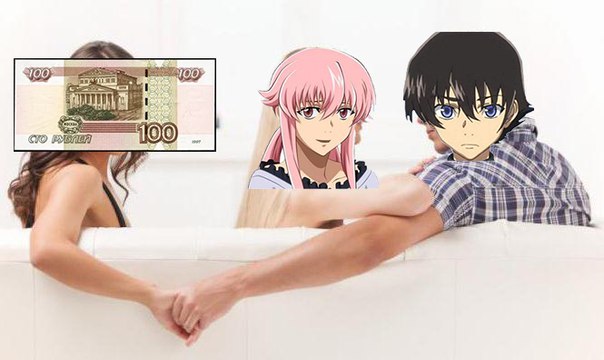
The illustration for the catalog entry combines a photo of a couple sitting on a white sofa holding hands with two characters from Japanese animation: a girl with pink hair and a young man in a checked shirt. A 100-ruble banknote is overlaid in the upper left corner. It is the banknote that links the picture to the phrase: it suggests the theme, but the words “Sanya, give back the hundred” are not written on the image itself.
This is a typical device of abstract memes: a collage of disparate elements where the meaning rests on a single object. The edges of the cut-out characters are visible, which is characteristic of mass user pictures of that period. The correspondence between the image and the catalog's description is broadly preserved: the theme of money is present, and the abstract character of the joke is clearly expressed.
Format and use
The meme is used as a short remark on a picture that needs no explanation in itself and works through contrast. The author publishes an image with an abstract subject and adds a phrase about returning a debt, and the reader fills in the story. The less obvious the link between the picture and the caption, the more readily the audience accepts the joke.
Over time, the phrase became a convenient shorthand: it is enough to write it to signal an absurd or meaningless post. For this reason, the meme appears more often in comments and captions, where it is needed to show that something is not to be taken seriously, than in extended stories or standalone texts.
Place in internet humor
The meme belongs to the part of Russian-language internet humor that values not the wit of the text but the structure of the joke itself. Such memes often have short lives but return as references, because a short phrase is easy to remember and easy to carry over to new pictures.
In an encyclopedic description it is important to note the limits of the source base. Information about the first appearance, authorship and spread of the phrase is not confirmed, so any dates and details beyond the catalog entry require separate verification before publication.