What's depicted
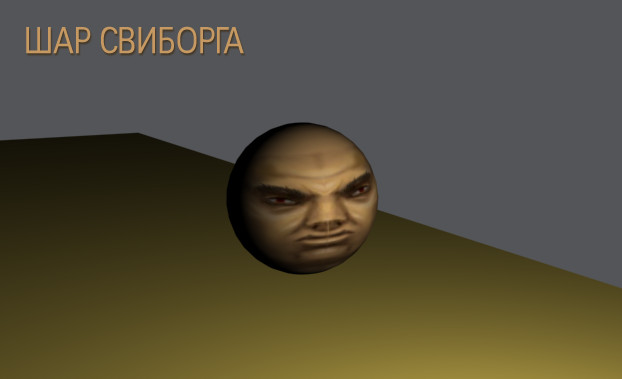
The picture shows a minimalist three-dimensional scene: a gray sky, a yellowish-brown surface with a warm glint, and a sphere at the center of the frame. On the sphere is a man's face with a low forehead, heavy brow ridges, and tightly pressed lips. The eyes look reddish, which adds to the sullen look. The caption "Sviborg's Sphere" is printed in large letters in the top left corner, like a cover title or a caption from an instructional video.
It's exactly the combination of clumsy geometry and a very serious expression that produces the main effect. The texture was clearly taken from a photograph or scan and stretched over the sphere without a careful unwrap, so the facial features shift slightly toward the edges of the sphere, and the gaze looks unnaturally intense. Viewers of the 2000s knew this kind of graphics well from early games with 3D models, amateur videos, and engine demos, which is why the picture looked recognizable to them.
Origin and spread
The image's exact origin has not been established. It most likely arose in the milieu of amateur experiments with three-dimensional graphics and was posted to one of the Russian-speaking imageboards in 2007. At the time, pictures like this got reposted from board to board, often keeping the caption in the top corner, and in the end the sphere became recognizable even by its silhouette alone.
The name "Sviborg" became attached to the character in the course of its spread. It sounds like a play on words based on a similarity to other names and words, though the source of this nickname cannot be identified with certainty. It also matters that the meme lived mainly as a picture, without any developed backstory or plot, so its spread rested almost entirely on the recognizability of its visual.
Use in comments
Like many early internet pictures, "Sviborg's Sphere" was used in comments as a reaction to something ridiculously overserious. A user would post the image under a text where someone was overdramatizing a trifle, or under their own account of some daily grind, and it worked through contrast. The face on the sphere seemed to say: "I understand everything, but I take it too much to heart." This tone suited self-irony, so the picture was often posted under people's own failures.
Over time, the image became part of a broader set of joke renders from the 2000s, where amateur graphics served as an occasion for irony about one's own aesthetic. Such pictures are now seen as a document of their era: they show what tools and what level of quality people used to create content for the internet back then.
Cultural context
The meme is interesting in that it rests almost entirely on its visual and requires no explanation. For part of its audience, it remains a nostalgic artifact of Russian-speaking imageboards, while for another part it serves as an example of how a simple model, lacking rich texture or lighting, can acquire character and turn into a recognizable figure.
The picture also illustrates a broader pattern of the early internet. In the absence of professional studios, the community created its own visual images and passed them around by hand. The sphere got its name and its place in everyday use not because it was conceived as a meme, but because many users decided to repost it and caption it.
Legacy
Today "Sviborg's Sphere" is known mainly to members of old forums and fans of retro aesthetics. Its value lies in how vividly it conveys the atmosphere of the mid-2000s: a raw three-dimensional render, a dead-serious face, and the internet's habit of turning any simple picture into an occasion for a joke.