What's depicted
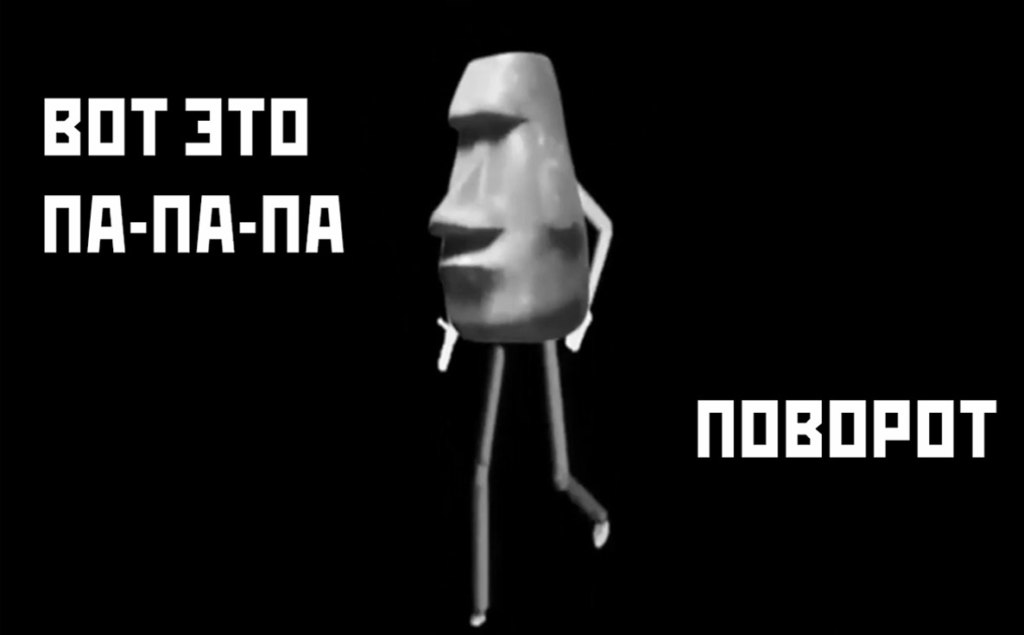
Against a black background, a gray figure walks in a black-and-white palette. Its head is a large stone slab with an elongated face, a heavy brow, a long nose, and protruding lips, very reminiscent of the moai statues on Easter Island. The body is reduced to a minimum: thin arms bent at the waist, and long thin legs, one of them stepping forward as if in a dance move. The image looks like a frame from a simple 3D animated clip.
The text is in an angular pixel font, split into three parts. Upper left reads "Now that's," below it "pa-pa-pa," and lower right, separately, "a twist." This layout creates a rhythm: first a surprised gasp, then a drawn-out, stammering "pa-pa-pa," and finally the key word, which arrives with a delay.
What's known about its origin
There's no confirmed information about who created this animation, where the figure came from, or where the phrase in this exact form first appeared. Guesses about a specific song or author remain unverified. All that's known is that it exists as a ready-made captioned image used in Russian-language chats and social media.
The expression "now that's a twist" is itself a common colloquial expression of surprise at an unexpected turn of events. The drawn-out "pa-pa-pa" turns it into a mock imitation: the speaker deliberately exaggerates the drama, as if commenting on a TV show plot.
Why it's funny
The main spring of the joke is the mismatch between the phrase's grandiosity and the character's appearance. A stone head is usually associated with monumentality and permanence, but here it's mounted on thin little legs, hopping along through emptiness. The serious face never changes, and that's exactly why the dramatic line sounds comical.
The sound also helps: reading "pa-pa-pa," a person can't help drawing the syllables out in their head, creating a tiny theatrical pause before the word "a twist" — and because of that delay, that word sticks in memory before the meaning of the whole phrase does.
Example captions
The picture is most often used as a standalone reply, but with a caption the joke becomes more precise. Below are made-up examples.
"Episode six of the show: turns out the butler is the main character's own brother." The meme highlights a plot twist nobody saw coming.
"Tapped my card at the store, and there's a promotion on exactly what I bought." A rare pleasant twist in an everyday situation fits too.
"You ask how someone's doing, and they launch into a three-minute story about changing careers." An unexpectedly long dose of openness is a great occasion for this reaction.
"Weekend plan: rest. Reality: moving in with friends clear across town." Here the joke is in the abrupt change of scenario.
Tips for using it
The picture works best for moments when the twist is genuinely unexpected, not just unpleasant. For ordinary annoyance, other templates fit better. Don't add long explanations: the phrase on the picture is already self-sufficient, and extra text kills the rhythm.
If you want to make your own version, keep the three-block text layout and the pixel font, or it will lose its recognizability. It's best not to crop the frame itself: the empty black space around the figure creates a sense of a scene and heightens the comic effect.