Two official expressions
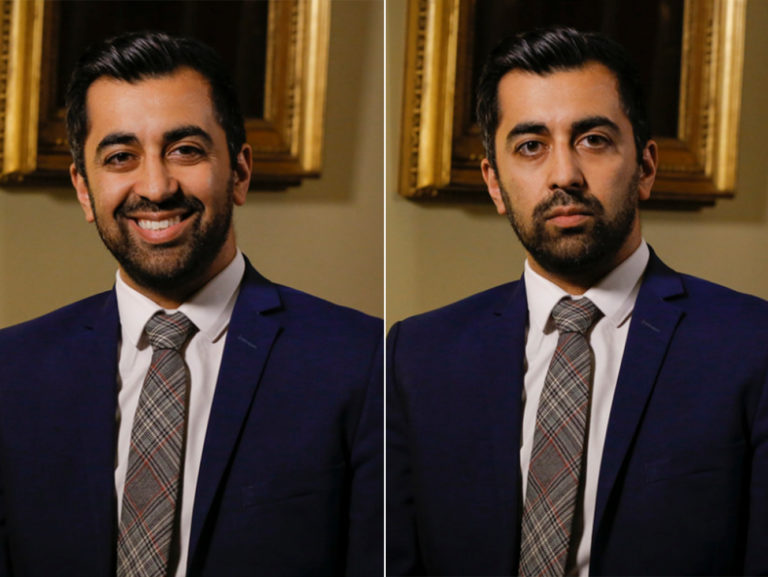
The photos show Scottish politician Humza Yousaf. In summer 2018 he took up the post of Cabinet Secretary for Justice, and a pair of his official portraits drew the attention of Twitter users. What stood out especially was how different the facial expressions were with an almost identical setup. In July posts, the photos were described as a ready-made set for good and bad news.
This pair has an explanation from first-hand sources. In a 2024 interview with the Institute for Government, Yousaf recalled the practice of official photography: he had to take a smiling portrait and a very serious one, which were then placed next to each other on Flickr. He himself noted that the juxtaposition of the shots looks funny and became a viral meme. This confirms the deliberate difference in poses, though it does not establish a single author of the first meme caption.
What the portraits share
Both photos show Yousaf from roughly the chest up, wearing a dark blue suit, white shirt, and checked tie. His hair is combed back; behind his shoulders a gold frame and a plain wall are visible. On the left he smiles; on the right his lips are pressed together and his gaze is stern. The portraits are arranged horizontally, so the reaction is naturally read left to right, not as a top and bottom response.
The identical clothing makes the comparison especially clean. There is no need to explain that a long story lies between the shots: the viewer almost immediately notices only the change of expression. At the same time, the editing alone does not prove a sequence of real emotions. The meme turns two staged portraits into conventional moments of one plot, which is created by the captions.
A change of expectation across two halves
In one variant the left side marks the first impression and the right side an unpleasant clarification. The smile then gives way to seriousness because of new information. In another, the sides represent two different offers: a pleasant one and an undesirable one. Such a format is akin to reactions of acceptance and refusal, but here the refusal is restrained, without a demonstrative hand gesture.
The official suit lends comic dignity even to an everyday choice. It can look as if you are discussing a state document, though the caption may be about an alarm clock or a menu. A serious portrait does not necessarily mean anger: it can convey disappointment, the need to pull oneself together, or a return to duties. The smile, in turn, signals the expectation of a pleasant outcome, not a specific political event.
Three invented pairs of news
First example: on the left, “The first class got cancelled”; on the right, “Moved it to Saturday.” At first the news promises a free morning, then the clarification takes away the day off. Second variant: “A friend said he cooked dinner” / “Now asks for help with all the dishes.” The contrast lies in the suddenly discovered price of a pleasant invitation, and the identical background turns the change into an instant reaction.
Third pair: “The letter says ‘congratulations’” / “It's a congratulations on successfully subscribing to the newsletter.” The smile expresses inflated hope, the seriousness a quick return to reality. All three situations are invented and have nothing to do with Yousaf's biography. The words on each side should be understandable on their own: the reader first accepts the good news, then discovers the detail for which two nearly identical portraits were needed.