What is visible in the picture
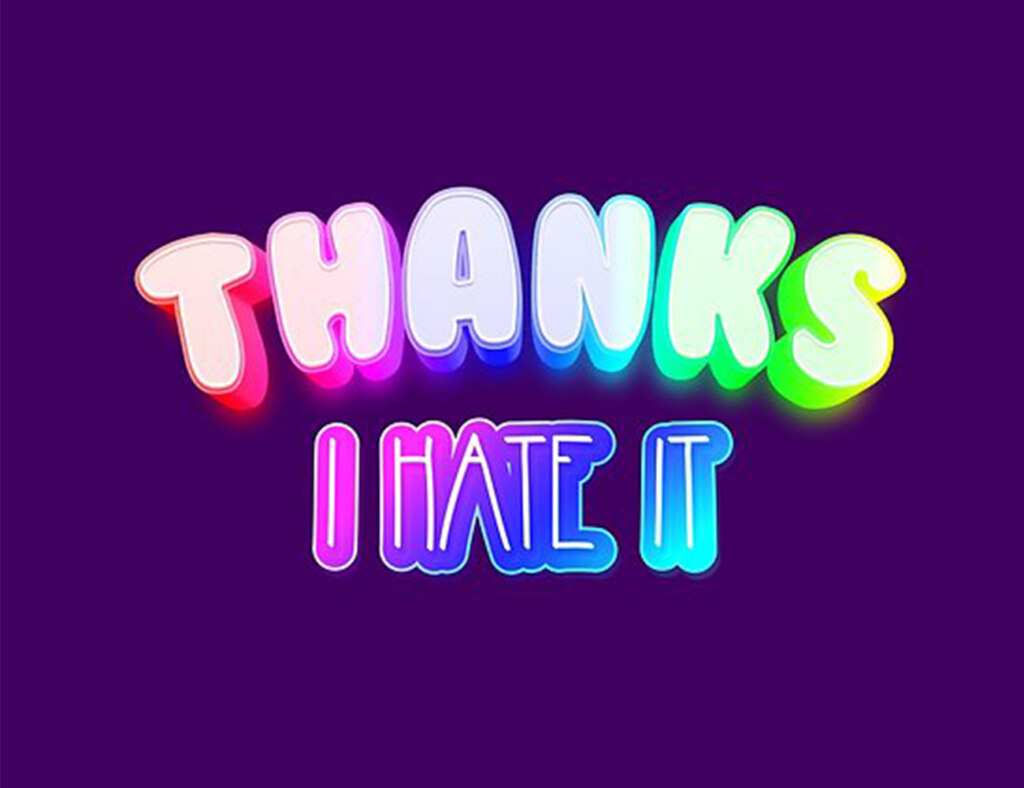
The image is not a screenshot of a post: it is stylized typography. The large word “THANKS” is written in white and gradient color with pink, blue and green shadows, and below it, in smaller letters, “I HATE IT” appears in a neon outline. The background is a plain purple with no people or other drawings.
This presentation makes the phrase look like a festive banner, and it is the contrast between bright gratitude and a text about something unpleasant that creates the humor.
Where the phrase came from
The origin of the expression is not established. The earliest known example is a Reddit post from September 24, 2017: in the community for the game Fire Emblem Heroes, someone showed a drawing of the character Ryoma. About a month later, a user left the comment “Thanks! I hate it” under such a post, expressing gratitude for an image they did not like.
The phrase spread quickly in the autumn of 2017, first in comments and then in post titles: examples include a post about a cat in a hat from October 30, 2017 and a post in a community about bad design from January 18, 2018. On Tumblr it was more often used as a tag, and one of the posts with the image gathered more than 100 thousand likes. The author who coined the phrase is not named, so it cannot be attributed to one person.
Later a community appeared that collected such unpleasant pictures in one place: by spring 2019 it had about 166 thousand subscribers. This shows that the phrase became not just a caption but an entire genre of strange and awkward images.
Meaning and the mechanics of the joke
The phrase describes a mixed feeling: the speaker thanks someone for something they possibly never asked for. The gratitude sounds polite, but “I hate it” reveals the real attitude. It is the pause between the two parts that creates the humor.
The phrase is short, so it is easy to apply to any unsuccessful result: a strange drawing, an absurd update, or an unexpected suggestion. Over time it came to be used as a headline format for odd pictures and short jokes.
Caption examples and how they work
Below are examples of captions. They all use one scheme: gratitude interrupted by an honest assessment.
“Thanks for updating the app: now the button has moved. Thanks, I hate it.” The gratitude sounds formal, and the final phrase turns it into irritation.
“Thanks for writing the report for me. Terrible, but thanks.” The gap between the polite opening and the displeased ending produces the funny effect.
“They gave me a cat for my birthday. Thanks, I hate it.” The joke rests on the contrast between a holiday and an inconvenient gift.
“Thanks for the idea at the meeting, it fell apart after three steps.” A concrete result makes the joke sharper: the viewer sees exactly what did not work.
How to use this template
Bold typography suits short captions and headlines where irony needs to be signaled. It works best when the gratitude and the displeasure refer to the same situation. If there is too much text, the effect blurs, so it is better to keep the caption to one line.