Three lines on one screen
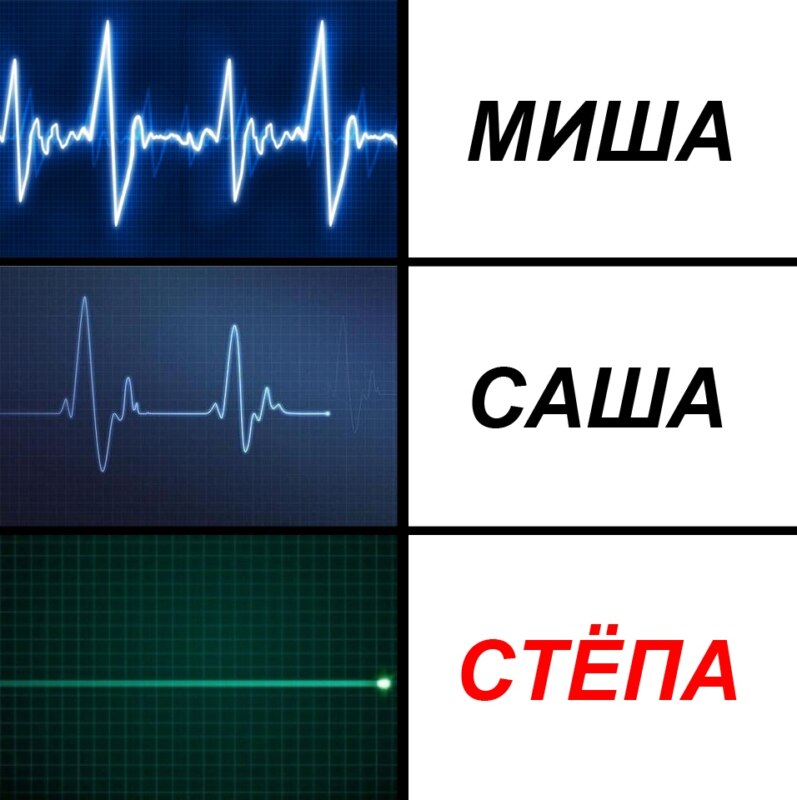
The picture is built on a simple scheme: three horizontal strips, each with a monitor image on the left and a large italic caption on a white background on the right. The top row is labeled 'Misha': on a dark blue background a bright white line with tall, frequent peaks, a dense rhythm. The middle one, 'Sasha,' looks weaker: on a blue-gray background the peaks are sparser, with long flat stretches between them, and on the right the line ends in a dot, beyond which a faint trace is barely visible. The bottom one, 'Stepa,' is shown on a green grid: a straight green line without a single peak, with a bright dot at the right edge. The label 'Stepa' is red, the other two are black.
The meaning of the layout is clear without words: the viewer sees a decline and understands on their own that the bottom line means stopping. The backgrounds of the strips vary, from blue to dark green, which emphasizes the transition from 'alive' to 'nothing.' The author of the template cannot be identified from the picture, and the origin of the caption with these names is not reliably established.
What is known about the caption
The phrase 'Stepa is gone' sounds like an announcement of loss, while the names 'Misha,' 'Sasha' and 'Stepa' are nothing special: ordinary names that can easily be replaced with any others. Who Stepa is and where the formula itself came from is not confirmed in verified sources, so a detailed origin story is not retold here. Versions about a specific character, in particular a pet of one of the video channels, are not confirmed.
The mechanics, however, are recognizable: an ECG in the viewer's mind is tied to a pulse, and a flat line means no pulse. The template carries this image over to any situation where something runs out: energy, supplies, patience, interest. The joke is built on comparison: the two earlier states prepare the viewer, and the third cuts off the rhythm.
The template does not work for jokes about the death or illness of real people. It works when something mundane 'dies': mood, an alarm clock, battery charge or evening plans.
Why mourning over a trifle is funny
The meme runs on exaggeration. The solemn language of a medical monitor is applied to a trifle, and that very seriousness makes the picture funny. Most captions do not explain what is going on: the viewer guesses from context, and the joke lands at the moment of the guess.
The gradation matters too. The first line sets the norm, the second shows the decline, and only the third puts the full stop. If you remove the second, the sense of a gradual fading disappears and the laugh turns into a simple announcement. The red caption at the bottom additionally draws attention to the ending, like an alarm signal.
Captions in the spirit of the template
The examples are invented for this template and are not quotations. All of them use three lines, the last of which goes out.
'Misha: showed up on Monday. Sasha: showed up on Tuesday. Stepa: showed up, but the line is already flat.' The activity scale carries over to ordinary work, and the last line unexpectedly becomes not about the heart but about laziness. The shift in meaning works: you expect one more step down and get a full stop.
'Misha — loves pizza, Sasha — loves pizza quietly, Stepa — there's no pizza left.' Here the everyday trigger and a short pause before the last word do the work. The ending means loss, but the scale of the object, a slice of pizza, makes the reaction absurd.
'Misha — passed the exam, Sasha — passed with difficulty, Stepa — passed on Friday evening and remembers nothing now.' The device is the same: three levels of one process, and the ending shifts the tone from tension to fatigue and burnout.
'Misha — the order arrived, Sasha — the order almost arrived, Stepa — the order went to another city.' The shift is clear right away: the last line sounds like mourning, though the subject is delivery.
How to use this template
The template is strongest when the three lines stay in the same order and the bottom one remains a flat line with a red caption. If you remove one of the lines, the scale loses its meaning: the viewer does not have time to feel the decline. Captions are best kept short, with one storyline across three levels rather than a long story.
It suits ironic situations like a lost item, a run-out supply or a cancelled plan. It does not work for real people and their troubles: it only works when the object of the joke is the drama itself, not the person in it.