What is visible in the frame
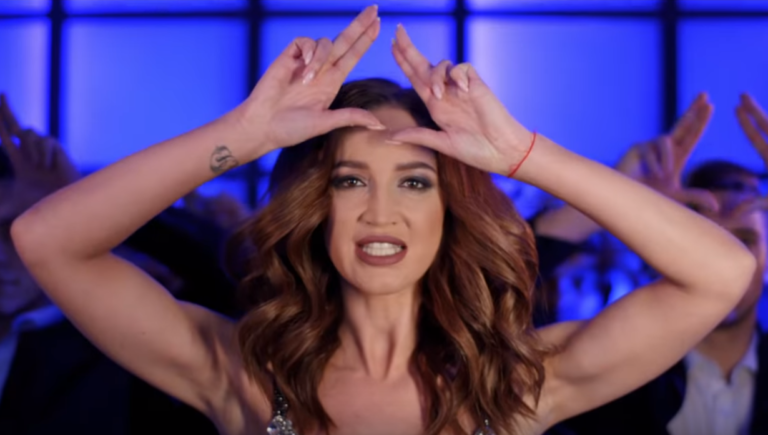
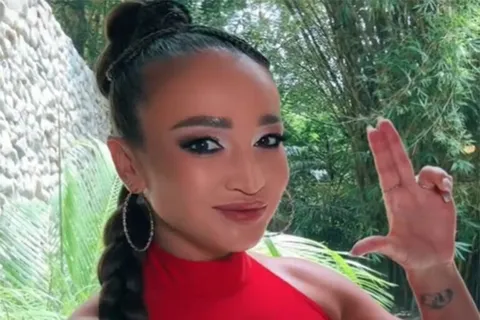
In the center, in close-up, stands a woman with long wavy chestnut hair. Both hands are raised above her head: palms pressed to her forehead, fingers stretched upward. Her mouth is slightly open, her gaze is directed straight into the camera, a red cord is visible on one wrist, and there is a small tattoo on her forearm.
The background is blue: behind her a grid of lit panels shows through, and at the sides blurred silhouettes of people are visible, whose hands are also raised. There is a shine on the clothing. This is one still moment, from which the sequence of movements cannot be understood, so it is not worth describing the dance itself from the frame.
The song and the flash mob
The flash mob is called “Dance to Buzova” and is built on the eponymous song by singer and TV presenter Olga Buzova. According to press reports, the song appeared at the turn of 2018 and 2019; the exact release date is not confirmed.
The moves to repeat were simple, so anyone who wanted could take part. The frame shows the characteristic gesture with hands at the head, but which place in the dance it occupies cannot be said from a single picture.
How such dances spread
A musical flash mob lives on the repetition of one simple gesture — hands raised to the head — which anyone can copy in a second. According to reports, this gesture was repeated by other artists, bloggers and ordinary social media users, although the exact scale and the chronology of participation remain unknown.
Three things matter for such a mechanic: a short chorus, a gesture that can be shown without preparation, and a recognizable picture for the preview. Raised hands above the head read well even on a tiny cover, so a static frame easily becomes a symbol of the whole flash mob.
Why the gesture became a template
The viewer sees hands above the head and mentally reconstructs the song and the movement. The result is a template of participation: the caption tells in what situation the person has suddenly “joined” the trend. The joke shifts from the performance itself to the person captioning the picture.
Captions about being pressured into having fun, about repetition, and about it being too late to refuse work well. Captions about the appearance or personal life of the frame’s heroine work worse: they pull attention away from the dance itself and give the joke no storyline.
Caption examples
Below are several invented captions. Each uses one device: an everyday situation and an unexpected conclusion.
“Friends asked me to dance at the wedding, I raised my hands and realized I was already in the feed.” The caption moves the flash mob from the screen into ordinary life, and the simple situation becomes funny.
“When the chorus plays for the third time in a day and my hands still go up by themselves.” A joke about habit: repetition brings it to automatism, and the gesture becomes a reflex.
“Nobody asked, but I’ll show once more how it’s done.” Irony about the urge to take part, which arrives with any repetition. It works through the contrast between a confident gesture and an overconfident caption.
How to use the frame
The frame fits texts about the song and the flash mob, jokes about dancing at parties, weddings and corporate events, and stories about how a simple gesture becomes mass entertainment. Keep the caption around dance, music and repeatability.
The strongest captions name the gesture itself — hands at the head — and tie it to a specific everyday situation, rather than trying to retell the whole flash mob story.