The scene from Wednesday
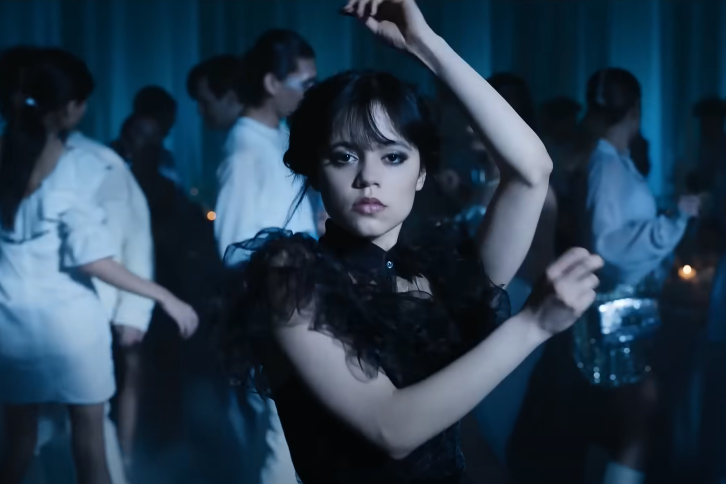
In the catalog photo, a heroine with dark braids dances among guests in blue-violet light. This is Wednesday Addams, played by Jenna Ortega, in the Netflix series "Wednesday." The scene is in the fourth episode of the first season, at a dance at Nevermore Academy. Ortega said she came up with the choreography herself; Netflix posted this clip separately. It is a staged scene, not a recording of a real dance event.
In the series, the dance is built on sharp, angular movements and contrasts with the usual expectation of smooth school choreography. The original scene uses the song "Goo Goo Muck" by The Cramps. Later, audiences began laying Lady Gaga's "Bloody Mary" and other tracks over the clip. Such a remix does not mean that the song played in the original episode.
Why the moves spread
The dance has easily separable moves: a raised arm, a head turn, rhythmic gestures and an unexpectedly serious face. They can be repeated in a short video even without a costume or set. The contrast itself helps joke about a person who doesn't adapt to the mood around them, or about an awkward dancer too confident in their own style.
In 2022 the video became popular in short social clips. The choreography quickly turned into a challenge and the basis for edits that swapped the music. The first copies and every step of the spread are hard to reconstruct, so the article can confidently link the trend to the series and the scene but should not declare any single clip the sole start of the global trend.
Original, remix and imitation
The dance has three distinct layers: the on-screen scene, the user remix with other music, and standalone repetition of the moves. It helps not to mix them up. For example, if a clip is edited to "Bloody Mary," that is a song laid over the scene, not the original soundtrack of the episode. And a person repeating the steps at home creates their own interpretation, not an exact reproduction of the shoot.
The template's popularity is explained by the combination of a recognizable character, simple gestures and the ability to fit various moods. Some versions deliberately present the moves as a serious performance, others make them silly. In both cases the joke should stay at the level of the pose or the contrast, without mocking anyone's appearance, illness or physical features.
Captions and adaptation ideas
For an everyday version: "Me at a party when my favorite song finally comes on." For a home video: "When they said I could pick the music for cleaning." In an office version, you can show a boring meeting with the caption "I heard the meeting was moved." If you film your own dance, adapt the moves to your space and don't disturb those around you.
A short edit can switch the music between two identical takes: under one track Wednesday looks menacing, under another she seems to be rehearsing for a family celebration. Caption: "Same dance, different plans for the evening." That makes clear what the audio switch does, and viewers don't mistake the remix for the series' official soundtrack.
If you use a frame from the show, leave context nearby that this is a character and a scene from a work of fiction. Let the new caption describe your situation rather than attribute real views or words to Ortega. The dance is recognizable without a detailed biography of Wednesday; a short joke about an unexpectedly serious attitude to an ordinary event is enough.