What is in the frame
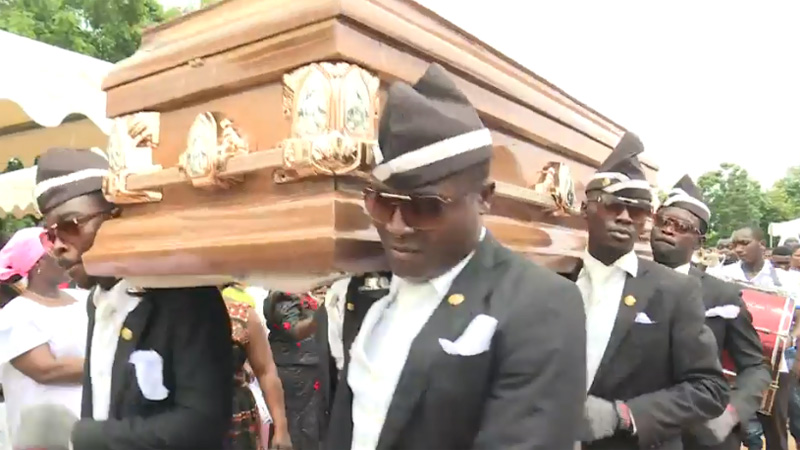
The shot shows several men in black suits and white shirts, with white handkerchiefs in their pockets and dark sunglasses. They wear black hats with a white band. On their shoulders they carry a light wooden coffin with gold decorative trim. Around them are people in light clothing, trees and a white tent. Everything is shot outdoors in daylight.
The frame itself conveys solemnity. The contrast with the dance and music of the video version is what made it a meme.
Who these people are
This is a group of professional coffin bearers from Prampram in Ghana, founded by Benjamin Aidoo. According to reference sources, he began this work in 2003 and later added choreography to the ceremonies. In Ghana, funerals often become large celebrations, and such a vivid form of farewell is not considered disrespectful.
The group gained worldwide attention after a BBC report aired in July 2017. Later the participants gave interviews and recorded a video, 'Stay Home or Dance With Us', urging people to keep social distance.
How the meme appeared
The bearers' dance videos were known earlier, but they became a mass meme in March 2020, when clips began to be paired with the track Astronomia by the Ukrainian-Russian musician Tony Igy (the version most often heard is the remix by the duo Vicetone). The combination of an upbeat electronic melody and a coffin proved powerful: the music made the scene cheerful, while the scene itself recalled death.
In the Russian-speaking internet the video became known as 'blacks with a coffin', while in English-speaking circles it is called Coffin Dance. The exact dates of the first cuts vary, but the peak came in April and May 2020, when people were sitting at home because of the pandemic.
How the joke works
The scheme is simple: something goes wrong in the video, a fall or a mistake with serious consequences, and then the insert with the dancing bearers follows. It is a comment that says 'it's over for him', expressed without words. The humor is built on unexpected lightness: we expect a tragedy and get a rhythm.
The meme almost always refers to an imagined end, not a real death. The best examples are about small things: a broken object, a slip-up, a ruined plan.
There is also a flip side: from frequent repetition the meme has become almost ritualistic. Viewers know in advance that after a failure the insert will follow, and they wait for it. From this come variants where the joke plays on the expectation itself: the video cuts off before anything happens, and the screen simply shows the dancers. This is also a form of humor: breaking a familiar pattern once it has become common knowledge.
Caption examples
'Me, when I said I would definitely get up at six tomorrow morning.' The caption predicts the inevitable outcome.
'My phone, after falling off the table.' A comic 'ending' for a gadget.
'My password, when I clicked Forgot Password.' A joke about the end of access.
'Vacation plans after the message about a schedule change.' A transfer into everyday life.
How to treat the meme
Use the meme carefully: behind it stands a real farewell ritual. Do not caption the frame with jokes about real tragedies or recent deaths.
A good caption shows that the joke is aimed at the situation, not at the people in the frame: the bearers know about the meme's popularity and played with it themselves in their videos.