A feed question that became a relationship script
Early versions of the question "Would you still love me if I was a worm?" can be traced to Twitter in June 2019: one user described an imagined late-night conversation with a partner and her anxiety over whether he would love her in a worm's body. By 2020 the phrasing had become especially recognizable as a joke a girlfriend asks her boyfriend, and it spread in short videos. Later on, not only the addressee changed but also the creature itself: versions appeared featuring a cockroach, a tank, and other absurd transformations. The dates of early posts record the examples available, not an absolute first utterance of the joke.
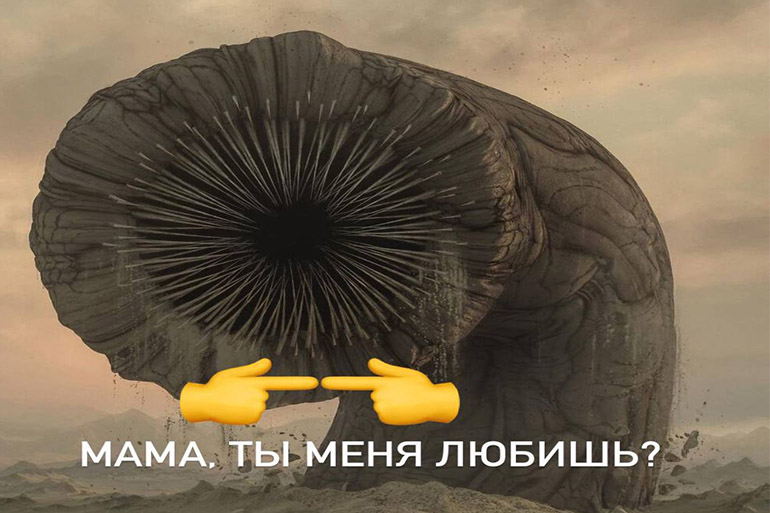
The local image differs from the typical couple's-template format: it shows a dark circle with radial lines, two yellow hands pointing toward the center, and a caption asking: "Mom, do you love me?" It adapts the theme of love to a conversation with a mother and uses the black circle as a visual puzzle. There's no worm actually depicted in this picture; the connection to the general entry comes from the catalog heading. Such images are captioned with things like "Mom, and if I were a worm — would you still ask if I'd eaten?", where the fantastical premise is immediately undercut by a perfectly ordinary parent's concern.
An absurd test of unconditional love
The joke tests a very serious question by attaching a deliberately absurd condition to it. The person asks for their feelings to be confirmed, but changes their appearance to the point of impossibility; the partner is forced to imagine what a relationship with a worm would look like. The comedy arises from the mismatch between the scale of love and the specific, strange transformation. This question is usually not a real plan or worry, although it can raise themes of acceptance, appearance, and the fear of being loved only for a certain image.
Later versions address a parent, a friend, or an audience, so the formula isn't limited to a romantic couple. The specific image in the collection chooses to address a mother, not to claim that a parent is obligated to answer a genuine test.
Variations with an absurd condition
For a text exchange with a friend: "If I became a tiny worm, would you still send me the bus schedule link?" Here the question about love is turned into concern over everyday logistics, which amplifies the absurdity. Another example, for family: "Mom, if I were a worm, would you still remind me to wear a hat?" The condition is fantastical, but the maternal habit remains recognizable.
For a pet, you could write: "If I were a worm, would you still let me on the couch?" The joke rests on the mismatch between human comfort and a worm's shape. These are new captions and don't describe the local image literally, nor are they historical posts.
Play with the question without turning it into an interrogation
The template suits a short message, a video of a loved one's reaction, or an image with an unexpected creature. The local version can be read as a more serious "Mom, do you love me?" — the contrast with the familiar comedic formula opens the door to a gentle joke about family care. If you specifically want the classic meme, spell out the transformation condition, otherwise the connection to the worm might not be obvious.
Don't use the question to test a loved one's patience after a real argument or to demand proof of love. In a real conversation, it's better to state the worry directly. If you're filming a parent's reaction, ask permission to post it; a spontaneous answer might reveal a private family exchange.