What's shown
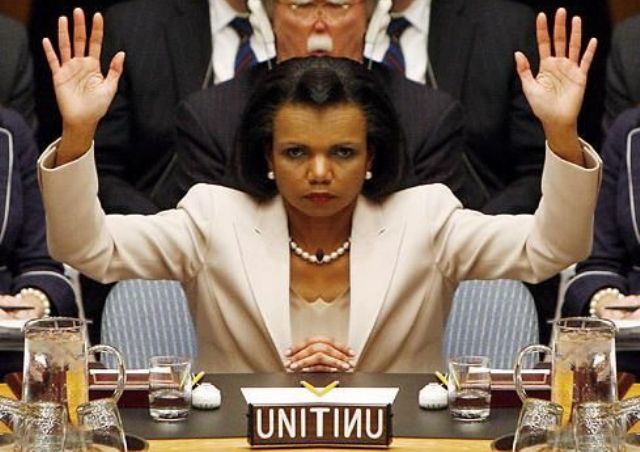
In the photo, a woman in a light-colored jacket raises both hands, her face expressing stern concentration. In front of her is a nameplate with the country's name, and figures in suits are visible in the background: the setting of an official session. The nameplate reads "UNITINU," that is, the word reflected in a mirror, and it's exactly this effect that makes the shot recognizable.
The photograph itself is entirely ordinary, with nothing comic about it. What makes it funny is the manipulation: the combination of a serious pose, a formal diplomatic setting, and a suddenly "readable" inscription creates the contrast the whole joke rests on.
Origin
The original photo dates to August 11, 2006, when Condoleezza Rice took part in a UN Security Council session and voted for Resolution 1701 concerning the Lebanon-Israel conflict. The photo was taken by Getty Images photographer Stephen Chernin. The shot circulated in the press as an ordinary news photo.
The mirrored version first appeared on the imageboard 4chan's /b/ board in late 2006. At first these flipped pictures were part of a general pastime: users mirrored well-known photos, hunted for hidden words in them, and shared their finds. The word UNITINU stuck as the name for the effect itself.
Further spread went through several platforms. In 2007 a Steam group and a Team Fortress 2 server named UNITINU appeared; in 2008 a dedicated entry went up on Urban Dictionary. The meme moved on to DeviantArt, YTMND, and Tumblr, and in 2011 a Mac app came out that let anyone mirror any image.
How it's used
The main technique is hunting for symmetry in well-known photographs. Users flip a picture and propose the word it now reads as, one that seems meaningful. That's how "UNITINU," "Nation of UNITINU," and other variations appeared. The joke rests on the recognizability of the original shot: without it, the mirror effect would just be a technical trick.
The format quickly spread to other officials and public figures. Mirrored photos of politicians with nameplates and flags appeared online, and each new "word" became an occasion for a joke. In this way UNITINU went from being the name of one picture to a genre: a mirrored photo with a found-word caption.
The same trick was applied to video too. Mirrored clips, including the Sega Dreamcast startup screen, produced a similar recognition effect. This is a matter of technique, not a political statement, and the format itself remains playful.
Why the meme caught on
The main reason is the game of perception. Mirrored text isn't read right away: the eye first sees familiar letters, then discovers a new word in them. This moment of discovery is pleasant and easy to reproduce, which is why the format was easy to pick up.
The second reason is irony aimed at officialdom. A photo of a diplomatic session, full of strict protocol, suddenly turns into an absurd jumble of letters. The meme works as a light parody of the solemnity of political rituals, but it doesn't turn the person themselves into an object of ridicule for their views or actions.
Finally, the format suited the internet community of 2006-2008: all you needed was to open an image editor, flip the photo, and suggest a caption. That simplicity gave the meme a long life, and the photograph remains one of the best-known examples of visual internet folklore.