What's in the picture
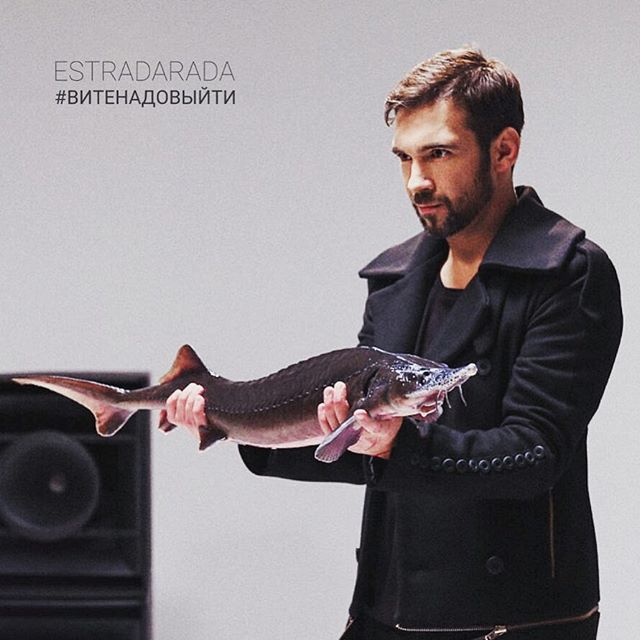
The image is a promo shot styled like a glossy photoshoot. In the top left corner is the lettering "ESTRADARADA" and the hashtag "#vitenadovyyti". In the shot, a man with short dark hair and a neat beard holds a large sturgeon out in front of him, stretched out horizontally. He's wearing a dark fitted coat with wide lapels and a dark t-shirt, the background is light and neutral, and a black speaker is visible off to the side.
The unexpected fish-based scene fits well with the group's absurdist aesthetic. The serious facial expression and polished presentation contrast with the mundane object, which in the frame looks almost like a prop. This approach creates a surreal image that pairs well with the song's lyrics and gets a smile even from people who've never heard the track.
The song's history
The song "Vite nado vyyti" came out in early 2017. According to journalists' accounts, its plot revolves around an imaginary Kyiv-to-Phuket flight in which a passenger asks to be let off at the nearest stopover: in Turkey, Egypt, on Samui, or on Phi Phi. The track is built on an electronic dance beat, and the chorus presents the request to get off as an urgent, almost dramatic demand.
The track quickly became an internet hit. According to media accounts, it started getting airplay on radio and TV despite the lyrics' certain crudeness, and videos and parodies of it spread across social media. It was precisely this mass virality that made the song one of the most notable musical phenomena of early 2017.
At the same time, the track itself remains light and playful, and listeners generally don't look for any serious subtext in its lyrics. In this it differs from songs the public perceived as social or political commentary.
Why the phrase became a meme
The main carrier of the meme was the refrain. Unlike many internet hits where the music video is what people remember, here viewers primarily remembered the desperate request to let Vitya off. The phrase slots easily into everyday speech and sounds both serious and absurd at the same time, which creates a comic contrast and makes it convenient for parodies.
Online, it's used in situations where someone needs to urgently leave a group, a meeting, a train, or an awkward conversation. People write it when someone is stuck in a line and wants to push their way to the exit, or when they need to get off public transport urgently. This usage turns the song's refrain into a universal template no longer tied to the specific storyline.
The musical form also played an important role. The electronic beat and rhythmic repetition turn the lines into a catchy chorus that's recognizable from just a few notes. Thanks to this, the phrase stayed in use for a long time even without context, and repeating it as a joke became its own type of internet humor.
Its place in culture
The meme reflects well the 2010s' tendency toward viral songs with a simple, repetitive refrain. Such tracks often don't require close listening, but they quickly become part of the shared vocabulary: people quote them in messages, turn them into captions, and use them as a short code for a situation.
The phrase "Vite nado vyyti" is functionally close to other song-based memes that stuck around thanks to a single memorable line. It can be compared to other song memes of that era, in which the plot took a back seat and the refrain spoke for itself.
Today the meme remains recognizable to those who remember the mid-2010s, and it continues to appear in captions and discussions as a reminder of a time when viral tracks made everyday humor shared across whole generations of users.