The history of reCAPTCHA and the meme's date
This CAPTCHA is tied to reCAPTCHA. Google acquired the project in 2009 and later used it widely for tasks where users mark every square in a grid that contains a given object, such as road signs, traffic lights or cars. Such tasks were a way to verify the user while also helping to recognize text and objects in images. The meme dates to 2016, which matches the period when grid CAPTCHAs spread widely, but the exact first post is not known.
A grid task is easy to copy: all you need is an image with neat squares and a line of instruction. That is why the format quickly spread beyond websites and became an entertainment template across social media and meme communities.
How the joke works
The main device is transferring the instruction. A real CAPTCHA asks about things a machine has to recognize, while the meme asks about things that are hard to recognize or not worth recognizing at all. Selecting squares that contain “anything” makes the task pointless, and ticking a tile turns into a small personal decision. What's funny is not the CAPTCHA itself but its serious tone and pedantic instruction, applied to absurdity.
This principle works well for captions. The format rests on a single phrase, so it is easy to adapt to any context, from cinema to office life. The text usually keeps its official tone while the object changes.
What the picture shows
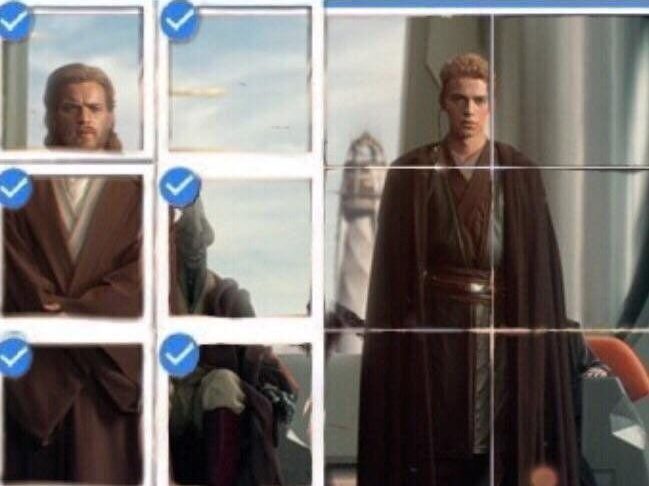
The picture shows a grid of six squares in two columns, plus a large frame on the right. On the left are two male characters in brown clothing, next to a pale sky and a piece of a hull. On the right is a close-up of a character in a long dark coat against a light interior. Judging by the costumes, these are frames with the young Obi-Wan Kenobi and Anakin Skywalker from the “Star Wars” saga; the exact film, episode and scene could not be reliably established for this article, so no film number is given. The tiles carry blue check marks, which in CAPTCHA interfaces signal a selection.
The composition works through recognition: viewers see a familiar scene, and the task invites them to mark its pieces as if it were an ordinary verification. The large frame on the right is not cut by the grid like the others, which adds an unexpected visual twist: the CAPTCHA seems unable to split the characters in half.
Example captions
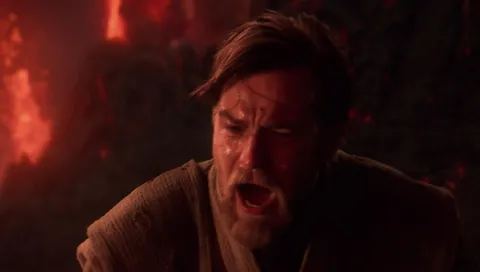
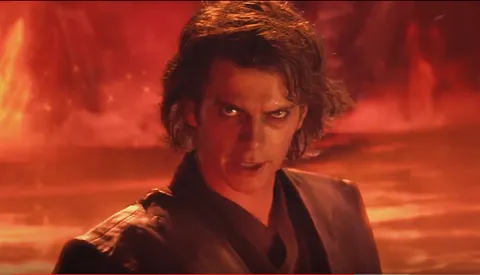
Short captions in the spirit of the original instruction work well. For example: “Select all the squares where Obi-Wan doesn't yet know how this ends.” The second builds on a famous line from the same scene: “Select all the squares where you're not yelling ‘I hate you!’” Both keep the bureaucratic tone and move a recognizable scene onto an unexpected plane. The shorter the wording, the stronger the effect, because the viewer fills in the context on their own.
Why the format endures
A grid task is a clear, self-contained template. It needs no explanation: viewers recognize the CAPTCHA instantly, and that is enough to get the joke. That is why these memes keep coming back whenever a new recognizable picture or a new reason to poke fun at services that ask you to prove you're human appears.
The meme is not tied to a single source. It exists as a set of similar images and captions united by one idea, so it is a format rather than a specific original post.