What is in the picture
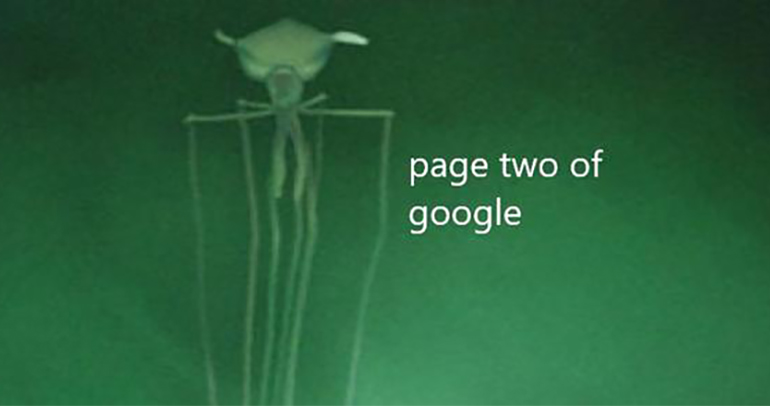
The frame is done in green tones, as if shot by a night-vision camera or through a thick layer of water. In the center is a dark creature with a rounded body on top and long thin tentacles that stretch down and to the sides at right angles. To its right, in white lowercase letters, is written “page two of google.”
The creature's outline resembles a deep-sea bigfin squid of the genus Magnapinna: such animals have very long arms with characteristic bends, like “elbows.” One cannot say exactly what is shown from a single frame, and for the joke this does not matter: it is enough that the viewer sees something otherworldly and rare.
Why the squid suits the joke
Bigfin squids live at enormous depths, by some observations more than four kilometers down, and the length of their arms can reach several meters. Only a few dozen encounters with them have been recorded, so every video of such an animal is considered a rarity.
This rarity is what makes the comparison work. Users are used to getting an answer on the first page of search results, and only a few open the second. Everything lying there seems to exist in another environment: dark, deep and not meant for visitors. The squid in the picture is a visible image of such a place.
How the joke reads
The meaning comes together from three parts: the habit of not scrolling past the first few links, the feeling that the following pages hide a strange and neglected internet, and the comic seriousness of a caption with no capital letters or punctuation. The calm text beside a frightening creature creates the effect of a dispassionate guide to the depths.
A caution is worth mentioning here too: the meme does not claim that there is really anything dangerous on the second page. It is an exaggeration, an image, not an assessment of the quality of specific sites. Expressions like “the second page of search results is the dark side of the internet” appear as jokes from various authors, but who first linked them to the squid picture is not known for certain.
Caption examples
“My search for a recipe when the first five links turned out to be ads” moves the viewer into the moment when they have to click “next” and accept the unknown.
“The link I found forty minutes and three refined queries later” shows the creature as a trophy that was pulled up from the depths.
“A 2009 forum with a single answer: problem solved, thanks everyone” is a joke about how the needed answer lies somewhere in the depths and does not explain how exactly it was found.
“What I see when I search for a song title from three words I remember” lets the picture answer instead of words, because a search result does not need explaining.
How to use the template
It suits jokes about searching, archives, searching email and messaging apps, deep sections of websites, and any situation where the answer exists but lies far from the surface. It works well if the caption says what is being searched for, and the picture only confirms the scale of the search.
Do not attribute malice to the search service itself or accuse specific sites: the power of the meme lies in ironic exaggeration, not in a grievance.