The profile format
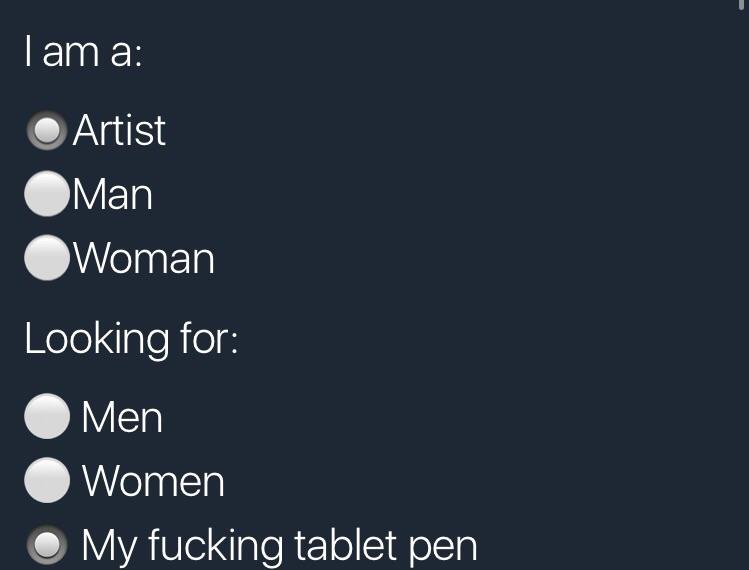
Dating sites have had a standard form since the early 2010s: the user picks a gender, specifies who they're looking for, and marks preferences with toggles or lists. This structure is so familiar that it's easy to parody, and the meme uses exactly that recognizable interface with round radio buttons.
The screenshot shows two blocks: "I am," with the options "Artist," "Man," and "Woman," and "Looking for," with the options "Men," "Women," and a third option. The third option is the person's own stylus, labeled with a crude swear word. This set of options makes the joke clear right away, even without any explanation of the picture.
Origin
According to the catalog tag, the meme dates to 2017. Who first posted the screenshot and where it appeared couldn't be established. Most likely it arose among digital artists discussing their relationship with their tools: a stylus and tablet are often seen as the other half of a creative life.
The genre of jokes about artists who prefer work to socializing existed before this. The meme simply transposes that familiar image into the format of a dating profile and makes it recognizable by relying on an interface everyone understands from dating sites.
How the joke works
The comic effect is built on a switch of expectations. The reader expects the usual options of "men" or "women" and instead gets an object. The more serious the profile looks, the funnier the unexpected line appears, and it's this mismatch that creates the main punchline.
Importantly, the meme doesn't mock a specific person. It's a generalized image of a creative person absorbed in their work process, and the joke relies on understanding their habits rather than putting them down.
Spread and variants
The profile quickly spread through reposts: artists, illustrators, and animators swapped in captions, substituted their own tools, and made their own versions. A variant with other objects — brushes, canvases, pencils — shows up in the same discussions. Sometimes the joke was continued in the comments, with people proposing their own versions for other creative professions, say photographers or architects, while keeping the profile's structure.
The format is also used in themed chats and communities, where members parody their own profiles. Quite often a stylus is swapped for coffee, a game console, or a keyboard, and then the joke shifts toward the broader topic of hobbies. Similar profiles with absurd answers regularly appear in parody communities, and each new version relies on the same principle: a serious form with unexpected content.
Cultural context
The meme reflects a commonplace of digital culture: creative professions are tied to technology and, at the same time, to attachment to one's tools. Hence the popularity of jokes about styluses, canvases, and brush settings.
For those who work with graphics tablets, the meme became a way to laugh at themselves. The profile needs no explanation and is easy to understand even for people who have never drawn with digital tools, which is why the picture keeps resurfacing in conversations about hobbies and creative work.