Why the word is recognized even though it sounds wrong
The English particle “n’t” is familiar from contractions like “don’t” and “isn’t.” Attached to “yes,” it creates a deliberately impossible combination: an affirmative answer receives a negative ending. The reader understands the word literally as “not yes” and guesses that it stands in for “no.” The humor relies on a familiar grammatical form applied to an unsuitable word. Such a remake resembles an overly zealous simplification of the language, in which one short answer is replaced by an artificial construction.
The older spelling and the petition of the new wave
The user-submitted entry “yesn’t” appeared on Urban Dictionary as early as 2008. The early definition described an ambiguous answer between “yes” and “no,” so the later story does not begin with the invention of this letter combination. Its popularity rose sharply in mid-May 2018, after a petition on Change.org proposed replacing “no” with “yesn’t.” It was promoted by a Reddit user named Snowicide, who posted a screenshot in r/me_irl on May 15.
In the discussion, the author answered participants with the same altered words and linked to the signature page. The campaign was part of the joke: even the question of whom the proposal was addressed to received a playful answer about the author himself. Signing and new pictures turned viewers into participants in an imaginary reform. The petition gave an already existing spelling a clear mass-media story: it became a word that was supposedly about to be officially put in place of the familiar negation.
Drake votes for a letter swap
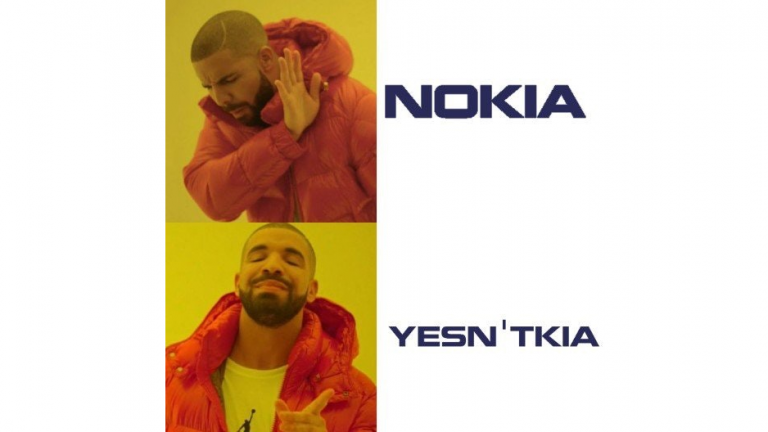
The image uses two reactions of rapper Drake from the 2015 music video for “Hotline Bling.” In the upper panel he turns away and raises a palm; on the right stands the dark blue NOKIA logo. In the lower panel he smiles and points to the second option, YESN'TKIA. The orange jacket and yellow background preserve the recognizability of the choice format. The video itself appeared before the language wave and contains no such phone joke. The author of the text remake has not been identified.
The second inscription arises from replacing the initial letters NO with YESN’T. This is a deliberately literal treatment: a negative answer is sought even inside a word where it negates nothing. The logo turns into an object of an overly consistent rule. Drake approves of the result as if it were a useful improvement, although the new spelling merely makes a familiar brand name longer and stranger.
The reform spreads beyond answers
In an ordinary line, “yesn’t” can sound like a comical dodge of a direct refusal. However, the pictures expand the game: they transform accidental letter coincidences, invent a reverse form “non’t,” or add the ending to other words. Each subsequent step depicts a bolder linguistic system that resembles living speech less and less. What is funny is not only the individual word but also the author's readiness to apply an invented rule without regard for meaning. The ability to recognize the original form remains the key to such a remake.
Three answers from an imaginary new dictionary
In an invented dialogue, a person asks whether there are any cookies left. A friend answers “yesn’t” and solemnly shows an empty box. The word does not hide the refusal: it makes the simplest answer resemble a linguistic achievement. Another possible meme formats a pass application form with two boxes, “yes” and “yesn’t.” The absurd complication appears in the place where an unambiguous choice is especially expected.
The third example continues the letter logic of the logo: a sign with the English word “north” becomes “yesn’trth.” The original name of the direction contained no negation, but the imaginary reformer still found NO and carried out the replacement. This variant requires remembering the original word, otherwise the viewer is left with a meaningless inscription. That is why the Nokia joke is read especially quickly: the recognizable logo makes it immediately clear what was changed and why the result looks absurd.