The format and its structure
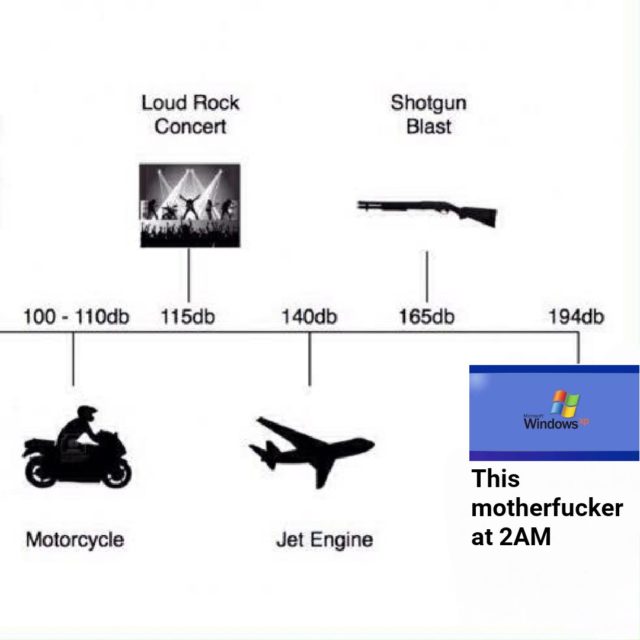
The scale underlying the meme draws on reference tables of sound levels in decibels. It marks familiar things: a motorcycle at around 100-110 dB, a rock concert at around 115 dB, a jet engine at around 140 dB, a shotgun blast at around 165 dB. This framing creates a sense of scientific precision, and that's exactly what the joke rests on.
The format is easy to adapt: the final entry becomes an exaggerated example that's supposed to sound louder than everything else. It's this entry that makes the picture a meme, because the real values fall short of the absurd finale.
It matters that the scale itself keeps a serious appearance: units of measurement, labels, and ties to specific objects create the feel of a teaching aid. That's exactly why any break in logic at the end looks especially funny. Creators often pick the entries so that the lower values look plausible while the top one stands out sharply from the rest.
The Windows XP example
In the version that made it into the database, the final mark — 194 dB — is labeled with the Windows XP startup screen and the phrase "This motherfucker at 2AM." The joke is that the old operating system sounds so loud on startup that it wakes a person in the middle of the night. The Windows XP startup sound still triggers nostalgia and is recognized by many users to this day.
The number 194 dB wasn't chosen at random: it's the theoretical limit for the loudness of sound in air at normal atmospheric pressure, beyond which the wave turns into a shock wave. So the joke combines real physics with hyperbole.
Origin of the format
Loudness scales in the form of comparative charts have existed for a long time and are widely used in textbooks and on hearing-health websites. The meme emerged as a parody of such charts, and its author is unknown: different versions change the labels, images, and final entries.
The name "Noise Level Charts" became attached to the format in the English-language internet. In the Russian-speaking environment, the picture took the name "The loudest sound" and spread widely in reworked versions.
Variants and usage
The final entry is often chosen to fit a specific audience: in some versions it's an alarm clock, in others a baby who starts crying in the middle of the night, or a neighbor with a jackhammer. Every variant works on the same scheme: a familiar noise turns into a world record.
Sometimes the format is used in discussions of gadgets, music, and everyday life, to compare different events by loudness as a joke. The point isn't precision but comic juxtaposition, so the picture stays understandable even without any knowledge of acoustics.
The format is also frequently used as a template for conversations about music and events. Creators compare the loudness of concerts, fireworks, and household appliances, and at the end place an entry that anyone who's ever lived next to a noisy neighbor will understand. Reworkings like this spread quickly because the topic is close to almost everyone.
Why the meme endures
The loudness scale combines two pleasures: recognizing a familiar infographic style and an unexpected finale. The viewer sees a familiar look and expects an explanation, but gets an absurd mark instead. That's why the format endures and keeps accumulating new variants.