What the picture shows
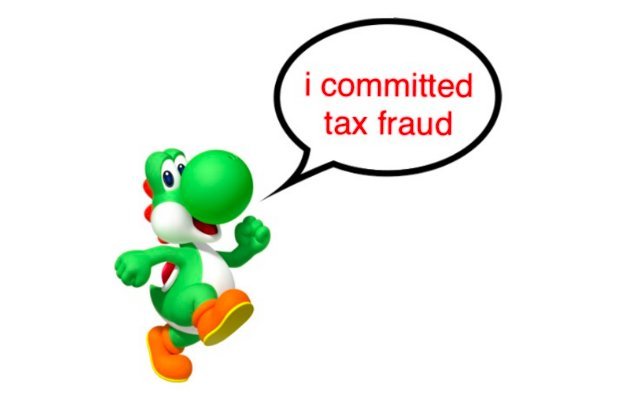
The picture has a white background and one character: the green Yoshi from the Super Mario series. He is walking or running with clenched fists pressed to his chest, has a red crest on his back and orange boots. Next to his head is a large white speech bubble with a black outline, and inside it, in red letters, is written “i committed tax fraud”. There are no other elements in the frame.
The image is made as a simple template: one character, one line and an empty background. Because of this it is easy to share and to place in any context, and the meaning reads in a second. Even the style of the caption, a plain font without decoration, resembles a dry official confession.
How it began
According to descriptions in meme catalogues, the accusation first appeared on Tumblr on May 28, 2016. The details of that exchange differ between retellings, so the exact course of the conversation cannot be reconstructed. What matters is that the joke lived for almost three years as an “old accusation” that supposedly was never proven or disproven.
Fans also found “evidence” in the games themselves. Most often people recall the 2011 game Fortune Street, where, according to player reports, Yoshi asks to be exempted from taxes. These retellings should be taken as part of the investigative game, not as documentary evidence.
2018 and the fictional game
The meme spread widely in 2018. Reportedly, in April, around the American tax deadline, the SiIvaGunner channel posted a music compilation presented as the soundtrack to a non-existent game about Yoshi’s tax fraud. The exact view counts are unknown, but after that the joke clearly took hold on social media.
The mechanics here are simple: a fantasy is presented as a document. The game title, the soundtrack and the serious tone create a sense of plausibility, even though no such game exists. People picked up the legend, added “courtroom” details and debated how the tax service would respond. It was this collective game that made the joke durable.
Why the joke works
Yoshi is a character with no job and no salary, so taxes formally don’t apply to him. The absurdity is doubled: the very idea of a dinosaur paying taxes is funny, and at the same time the phrase carries legal language: “evasion”, “fraud”. The contrast between the character’s bright children’s style and adult wording works like a short plot in a single line.
It is important that this is a fictional character from a game. A joke about his imaginary finances does not touch real people, and that is why its harmlessness raises no questions.
Caption examples and how they work
“Reported on the fruit I ate. Tax office hasn’t audited yet.” Fruit is a recognizable detail of the Yoshi games, and the word “reported” moves it into accounting. The game habit becomes a confession.
“Declaration: income — coins, expenses — zero, no questions.” Coins are collected on every level in the games, and the caption transfers this mechanic into a tax form. The drier the tone, the funnier the absurdity.
“Yoshi asked not to ask where he gets so many coins.” The effect here is built on a role switch: a character who collects coins for the game suddenly starts guarding a secret, like an ordinary taxpayer.
All three captions take a familiar game mechanic and translate it into the language of taxes. The device works as long as the shift stays sharp: if the caption is long, the effect disappears, so it is better to stick to one short phrase.
How to use this template
The picture suits captions about strange statements that sound official. The white background is neutral, so the text in the bubble should be short: one phrase reads better than a paragraph. The text can be replaced with any “confession”: from a minor everyday misdemeanor to an imaginary crime against bureaucracy.
The template works well with playful and absurd humor. It is not suitable for real people, because then the joke becomes an accusation rather than a game.