What the picture shows
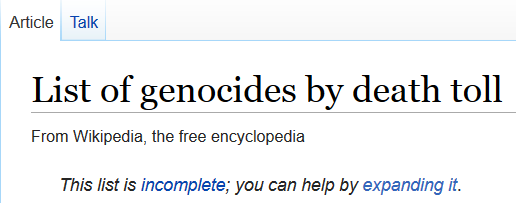
The screenshot shows a typical page of English-language Wikipedia: the “Article” and “Talk” tabs at the top, a large title “List of genocides by death toll”, the subtitle “From Wikipedia, the free encyclopedia”, and below it, in italics, the standard MediaWiki notice: “This list is incomplete; you can help by expanding it”, with the words “incomplete” and “expanding it” styled as blue hyperlinks.
Origin of the format
“You can help by expanding it” is not a joke in itself but a system message from Wikipedia’s MediaWiki software. For years it was automatically added to stub articles and incomplete lists, inviting editors to flesh out the material. The line has existed on the site since the mid-2000s as part of its template system.
As an internet meme, the format took shape around the mid-2010s, when users began deliberately picking article titles on dark, violent or socially awkward topics (lists of disasters, crimes, extinct species and so on) and attaching the screenshot with the standard phrase about “helping to expand it.” The effect relies on the clash between Wikipedia’s neutral bureaucratic tone and the eerie or inappropriate subject of the title.
How the joke changes meaning
Originally, the call to “help expand” an article meant a literal editorial action: adding text, sources, links. In memes, the suggestion is taken literally in a darkly humorous way. “Help expand the list” reads not as “edit the text” but as “personally add one more entry to this list” — that is, an implicit invitation to carry out the action the article describes.
Typical user captions for such a screenshot: someone commenting under a repost of an article titled “List of the Biggest Exam Failures” writes “well, who’s in?”, or someone attaches a screenshot of an article on construction-site accidents captioned “I’m ready to help.”
Where and how it spread
English-language meme encyclopedias record the format as an established internet phenomenon. It was actively reposted on Twitter/X and Reddit, where users competed to find the most unexpected or absurd article title for the screenshot. Sometimes an image of a grinning character or an emoji was added to heighten the irony between the harmless wording and the frightening content.
The format’s own irony is also noted: over time Wikipedia itself partly dropped this stock wording in some sections of its interface, prompting some media outlets to discuss how “the meme outlived the phrase that gave birth to it.”
Why the format endures in culture
The meme’s longevity comes from its universality. The template needs no picture of a face or a character: a Wikipedia page screenshot is enough, and it is easy to fake or to find ready-made by picking a suitable article title. The format also reads well without translation, since encyclopedic bureaucratic language is recognizable in any language. This helped it spread beyond the English-speaking internet, including to Russian-language public pages, where the phrase was translated word for word.