A calculation at the blackjack table
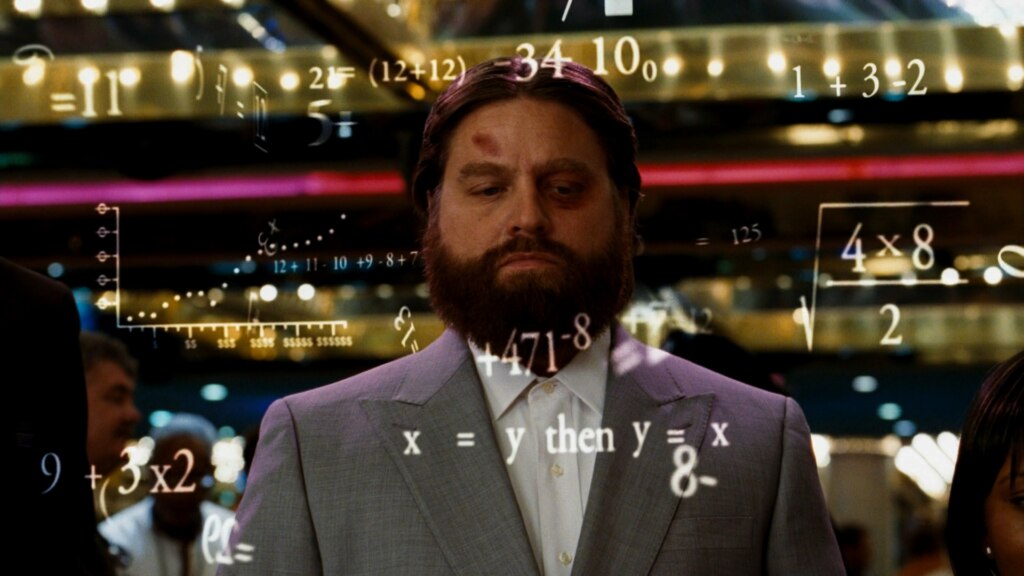
In the comedy “The Hangover,” Zach Galifianakis plays Alan Garner, one of the members of the trip to Las Vegas. The film was released in American theaters on June 5, 2009. Before going to the casino, Alan studies a book on card counting and then applies what he read at a blackjack table.
The camera shows his concentrated gaze, and numbers and mathematical notes drift over the frame. The editing lets the viewer seemingly look into the character's head. In the context of the film, this is a moment of Alan's unexpected competence; in memes, the same external seriousness often accompanies confusion. The result is a comic mismatch between the appearance of a complex calculation and the task the person is being asked to solve.
From the 2009 scene to a reaction in conversation
The casino scene appeared on screen long before the best-known online versions. Among the early surviving examples is a GIF posted on Imgur on August 31, 2014. In February 2015 the scene was used on Reddit as a reaction to a remark by a conversation partner who suggests guessing the reason for her displeasure on one's own. These are separate traces of distribution rather than proof of who first came up with the template.
The image continued to spread in the mid-2010s. In January 2017, a Tumblr collection appeared with an arithmetic error: squaring the number 15 was confused with multiplying by two. Alan's expression turned the wrong answer into an excuse to depict an excessively strained calculation. In other variants, math gave way to any questions the character cannot answer quickly.
Formulas as a visible inner monologue
Overlaid notes indicate the work of thought, even when the viewer doesn't read individual symbols. The face and the formulas give two layers of meaning: the person looks confident, but his head is busy with a painful search for an answer. A caption can emphasize either the real difficulty or the comic disproportion of the effort.
For example, a task of calculating the total budget really requires attention. But trying to figure out how many days are left until Monday on a Sunday evening is funny for its very simplicity. The same frame allows both readings. The conditions written above the picture set the difference: without them, the serious expression alone does not say what exactly the character is calculating.
A still frame and a moving thought
In this version, Alan is shown with several overlaid head positions, and formulas fill the space around his face. Such editing preserves the impression of continuous calculation even without animation. The gray jacket and dark background refer to the casino scene, but knowledge of the plot is not necessary to understand the new joke.
In the GIF, the movement of the gaze makes the wait for an answer longer. A still picture leaves the viewer with a single moment of concentration, which is convenient to place under a question or send as a separate reaction. That is why there are both captions about calculations and replies to unclear messages: instead of an explanation, the person shows how hard he is trying to make sense of it.
Three new tasks for Alan
For your caption, you can take a small calculation with unexpectedly long conditions: “Splitting the delivery four ways, but one person ordered only the sauce, and the promo code was mine.” The formulas here depict not a school equation but an attempt to account for all the caveats between friends.
Another example: “Calculating how much I saved at the sale after buying three more things.” Or: “Trying to figure out which time zone the call was scheduled in.” These invented situations share the need to turn everyday words into numbers. Alan's expression adds to them an exaggerated seriousness and a recognizable feeling: the answer seems to be close, but it still won't add up.