A frame with an unexpected hero
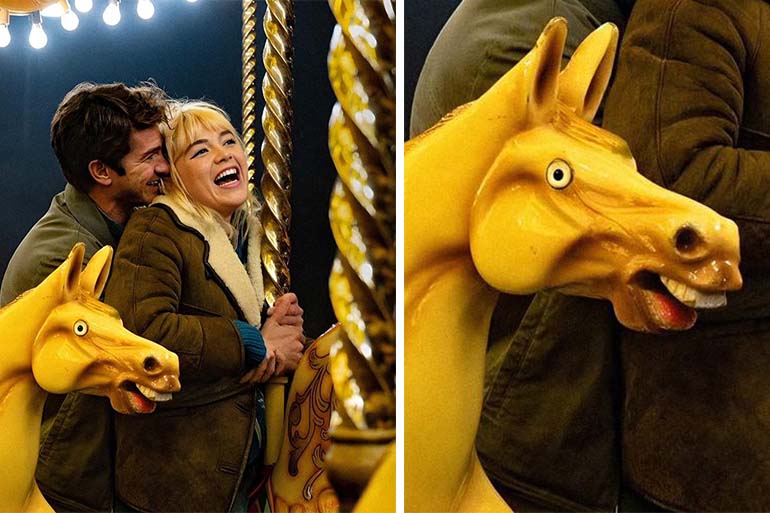
On August 13, 2024, a promotional image from the romantic drama "We Live in Time" was published online, showing the characters played by Andrew Garfield and Florence Pugh riding a carousel. But next to the actors was a bright yellow horse with wide-open eyes and an oddly tense expression. Users began discussing not just the film but the toy prop that unexpectedly became the main focus of attention.
The shot was part of the film's advertising campaign, not a separate shoot staged specifically for a meme. In the image the actors occupy a noticeable part of the frame, but the viewer's gaze catches on the carousel horse. This visual accident neatly illustrates how internet attention works: an audience can choose a secondary detail and make it the center of discussion.
Why the horse's expression became meme-worthy
The horse looks as if it were frightened or saw something incomprehensible. It has round eyes, a slightly open mouth, and a tense profile. These features resemble a human reaction of bewilderment, so the picture easily takes a caption about sudden realization, an awkward conversation, or an unexpected turn. The humor comes not from the toy being poorly made, but from the contrast between a romantic scene and its anxious "neighbor."
Users began photoshopping the horse into other famous scenes, changing backgrounds, and inventing different roles for it. Unlike memes with ready-made phrases, the main thing here is visual reaction. The horse can be turned into a witness to someone else's conversation, an accidental participant in a family photo, or a character who noticed the problem before everyone else.
What is known about the film
"We Live in Time" is a romantic drama directed by John Crowley starring Garfield and Pugh. The film follows the long history of a couple's relationship and how their life and family change. The carousel frame was one of the early promotional images, but the yellow horse is not a key part of the plot. It drew attention because of its unusual design and placement within the composition.
Later, the actors themselves reacted to the fact that viewers' attention focused on the horse. Such reactions boosted the meme's popularity, but do not mean the studio ever intended the horse to be the central symbol of the advertising campaign. Online success often comes from details the creators never planned to emphasize.
Local version and caption variations
In the catalog file the horse is shown from several similar angles, with Garfield and Pugh visible nearby. This is not a separate photograph of a real animal or an illustration of a specific scene where the horse participates in action. The image is connected to promotional material and preserves the main feature of the viral version—the wary gaze of the yellow carousel horse.
For example: "We agreed to pick a movie in five minutes. The carousel horse already knows the argument will last an hour." Or: "When the person you're talking to says 'nothing's wrong,' but you hear a sound from the kitchen." Such captions use the horse's expression as a reaction. There is no need to repeat jokes about the toy's looks; it works better to come up with a relatable scene in which a bewildered character witnesses what is going on.
Why secondary details become heroes
A film is advertised through actors, title, and plot, but a meme sometimes arises around a prop, an editing mistake, or a random object. A user is not obliged to share the attention the creators intended: it's enough for a detail to be unusual, noticeable, and open to reinterpretation. The yellow horse meets these conditions: its face stands out brightly, and the emotion is easy to read without words.
This template reminds us that viral popularity does not always speak to film quality or public reaction to its plot. It may point to a successful visual accident. If discussing a meme along with the film, it is important to distinguish the promotional photograph from the story's content, so as not to create a false impression that the carousel horse is the main character of the romantic drama.