Two frames side by side
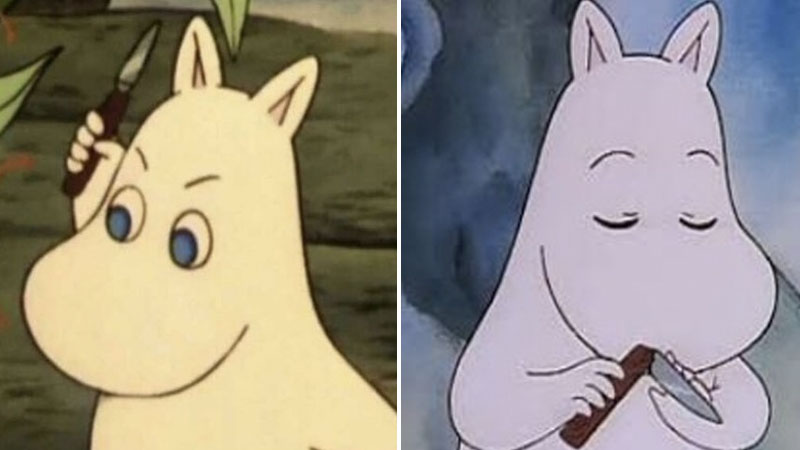
On the left, a character of creamy-white color with large blue eyes looks straight at the viewer. In his paw is a knife raised to his head, and dark greenery sits in the background. On the right, the character is paler, with a lilac tint, eyes closed, lips slightly smiling. He holds a knife and a wooden stick, as if carving or sharpening something, and the background is bluish-gray.
The different colors and drawing style suggest the frames come from different places, possibly from different episodes or versions of the cartoon. The meme sets the order in advance: tension on the left, calm on the right.
Where the hero comes from
Moomintrolls were created by the Finnish writer Tove Jansson: first as books, later as comics, cartoons and series. The characters are known as good-natured creatures who value coziness and calm, which makes the contrast with the knife especially noticeable.
Which exact series and episode these two frames come from is not reliably established. Some versions point to Japanese animated series about Moomins from different years, but the frames cannot be confidently tied to a specific episode. For describing the template, this is not necessary.
How the template grew
The date of the very first publication cannot be determined. The meme took shape within the Russian-speaking part of the internet and rests on comparing two stages of a state: first irritation, then outward calm. Over time, variants appeared where the left side shows the cause of anger and the right side shows the result.
It is important that the knife here is figurative. It is not a scene of violence but a way to show an emotion. The cute cartoon hero softens the image, so the theme of “pushed too far, but it’s passed now” reads as a joke rather than a threat.
What the reaction means
The meaning of the template is the transition from anger to calm. In the first frame the character is wary and determined. In the second, the eyes are closed, the gaze turned inward, and the emotion seems to have switched off.
This contrast fits when a person has built up irritation, vented it, and now pretends everything is fine. Sometimes the meaning is different: the left side shows “how I look when I’m angry,” and the right side shows “how I look once I’ve already decided what to do.”
Captions for the two stages
The scheme has two stages, and captions work best when they describe both. The top line sets the irritation, the bottom line captures the calm.
Top: “Friday, and at the office they are redoing the report again.” Bottom: “I am calm, I’m just busy with the stick.” The bottom line explains the shift, and the picture confirms it visually.
Top: “When the neighbor turns the drill on again at nine in the evening.” Bottom: “Okay, calm now, the neighbor has finally turned off the drill.” The everyday trigger makes the joke relatable, and the change of mood is its spring.
Top: “When someone in the chat replies ‘ok’ instead of a detailed answer.” Bottom: “Okay, I just closed the tab.” A sharp change of emotion works like a precise pause in comedy.
Top: “When you finally understood the instructions to the end.” Bottom: “Now I see why I was angry about the first page.” The shift from anger to calm explains the very cause of the irritation.
How to use the template
For the caption, it is best to take two linked sentences: the first about irritation, the second about calm. The image suits gentle self-irony, work chats, and jokes about procrastination.
The scene is simple, so the text should be shorter than the picture. If the two lines end up longer than the image itself, the joke loses its rhythm. The template should not be applied to real conflicts involving people: it is funny only while the subject is minor irritation.